
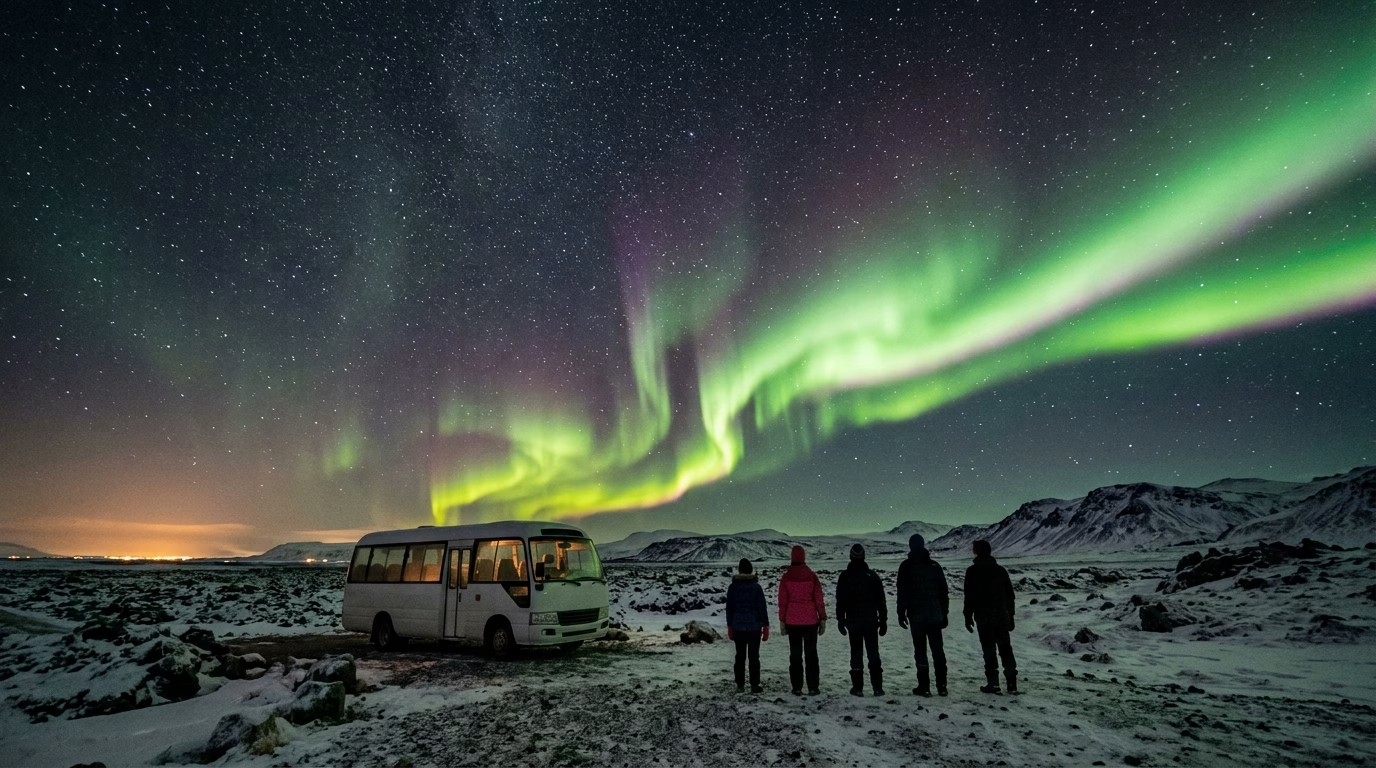
A northern lights tour from Reykjavik is the easiest way to see the aurora on a city-based trip to Iceland. You stay in a warm hotel, a guide reads the forecast, and a driver takes you to darker skies after dinner. This guide covers when to go, which tour type fits you, what each one costs, and what happens if the sky stays dark.
Set up your Iceland eSIM before you fly. Pickup changes and forecast updates then reach you even after you leave hotel Wi-Fi.
Key takeaways
- The aurora season around Reykjavik runs from late August to mid-April. Clear skies matter more than the date.
- Large bus tours start at about 9,000–10,000 ISK. Small-group minibuses run about 13,000–21,000 ISK, and boat trips about 13,500–14,500 ISK.
- Most operators offer a free retry if the tour runs but you see nothing. A cash refund is rare in that case.
- Book your first attempt for your first or second night, so you have spare evenings for a retry.
- Dress for standing still in the wind for 20–40 minutes, and keep your phone warm in an inner pocket.
Why Should You Experience the Northern Lights in Iceland?
The northern lights feel different in Iceland because the landscape becomes part of the show. Green ribbons can rise above black lava fields, snow-covered ridges, or the dark North Atlantic. Even a faint glow can shift into moving arcs within minutes.
Reykjavik makes a practical base. You can enjoy restaurants, museums, and comfortable hotels before heading into darker surroundings. You do not need to drive unfamiliar roads at night, either. A guided northern lights tour from Reykjavik handles the route while you watch the sky.
You also have several ways to see the aurora. Bus trips leave the city for darker inland areas. Boat tours trade roads for open views from the water. Longer day trips can combine Icelandic scenery with an evening aurora search.
- Choose Reykjavik for convenience: You can return to a warm city hotel after several cold hours outdoors.
- Leave the bright center: Streetlights around Laugavegur and the harbor can weaken your view of faint auroras.
- Keep expectations realistic: The aurora is a natural event, not a scheduled performance.
The experience often begins more quietly than photos suggest. Your eyes may first notice a pale gray band, while your phone camera records stronger green tones. As your night vision adjusts, the shape and movement become easier to see.
You should also expect waiting. Much of an aurora outing involves scanning dark skies, warming up, and moving when clouds block one area. That uncertainty makes a sudden burst of color feel earned rather than staged.
Takeaway: Use Reykjavik as your comfortable base, then leave its city lights for Iceland’s darker landscapes and open skies.
When Is the Best Time to See the Northern Lights From Reykjavik?
The main viewing season runs from late August through mid-April. Reykjavik has too much daylight around midsummer for a dark-sky aurora tour. Darkness, clear skies, and solar activity must line up at the same time.
September and October often give you a useful balance. Nights are properly dark, yet roads usually have less snow than in midwinter. Expect rain, strong wind, and fast-moving clouds. Waterproof layers matter more than heavy expedition gear.
November through January brings the longest nights. Around the December solstice, Reykjavik gets only about four hours of daylight. That gives a northern lights tour from Reykjavik a long viewing window, but Atlantic storms can bring thick cloud, sleet, and difficult roads. If you are weighing Iceland against other winter trips, see where else to go in Europe in December.
February and March are strong months for a northern lights tour from Reykjavik. You still get long periods of darkness, while daylight leaves more time for sightseeing. March can stay snowy and windy, so spring on the calendar does not mean mild weather in Iceland.
- September–October: Milder temperatures and easier daytime touring, but rain can block the sky.
- November–January: Maximum darkness, with the highest risk of storms and road delays.
- February–March: A practical mix of dark nights and longer days, though conditions still change quickly.
- Early April: Possible, but the shrinking dark window gives you less time for a sighting.
Cloud cover matters more than cold. You can see the aurora at temperatures above freezing, but you cannot see it through a solid cloud deck. A bright moon may soften faint colors, yet it rarely ruins a strong display.
Check the Icelandic Met Office aurora forecast before pickup. It pairs a cloud cover map with an activity score from 0 to 9. Look at the clouds first. A modest score of 2 or 3 can still produce visible lights over Iceland, while a high score means little under overcast skies.
Watch out: Do not cancel just because Reykjavik looks cloudy at dinner. Your guide may drive toward clearer skies on the Reykjanes Peninsula or inland, where conditions can differ within an hour.
Takeaway: Choose September–October or February–March for the best balance, then judge each night by cloud cover rather than the calendar.
Which Northern Lights Tour From Reykjavik Should You Choose?
Your choice of tour shapes the whole evening. A large coach keeps costs down, a boat adds coastal views, and a private vehicle gives you more control. Prices below are typical starting fares for a Reykjavik northern lights tour in the 2026–27 season. Check the operator’s own page before you book.
- Large bus tour — about 9,000–10,000 ISK, 3.5–4 hours: You leave Reykjavik with a big group. The route is chosen for cloud cover and road conditions. Reykjavik Excursions runs one of the longest-standing versions. The heated coach is a warm place between stops, which helps on windy nights. Boarding takes longer, and popular stops can feel busy when several buses arrive together.
- Minibus tour — about 13,000–21,000 ISK, around 4 hours: You travel with fewer passengers and usually board faster. EastWest, for example, caps its small-group tour at 19 people. A smaller vehicle can also use pull-offs that are awkward for full-size coaches.
- Boat tour — about 13,500–14,500 ISK, 2–3 hours: Elding and Special Tours sail from the Old Harbour into Faxaflói Bay, away from city lights. The skyline adds a striking foreground for photos. Rough water can be uncomfortable if you get seasick, so take motion-sickness medicine before you board rather than after symptoms begin.
- Private tour — about 150,000–260,000 ISK per group, 3–4 hours: Your guide adjusts stops around your pace, photography goals, and start time. This suits families, couples, or anyone who wants fewer people nearby. The per-person cost drops when your group fills the vehicle.
For a first northern lights tour from Reykjavik, a minibus often gives the best mix of comfort and flexibility. A large bus suits a tighter budget. A private trip makes more sense when photography or mobility needs come first.
Boat tours offer a different atmosphere, but they cannot sail around a wide weather system. A road tour can drive toward clearer patches inland. Choose the boat for the sea and the open horizon, not because it improves your aurora odds.
Watch out for vague vehicle descriptions. “Small group” does not mean the same thing everywhere. One minibus tour caps at 19 travelers, while another lists 28. Before paying, confirm the maximum group size, pickup point, and walking distance from your hotel. Ask whether there is room for a tripod or mobility aid.
Pickup messages often arrive by email or text in the last hour before departure. With your Telekonek eSIM already active, you see them in time, even on the walk to the bus stop. Reykjavik has several numbered pickup stops that are easy to confuse with nearby hotel entrances, so save yours offline as a backup.
Takeaway: Choose a coach for value, a minibus for balance, a boat for scenery, or a private vehicle for control.
What Does a Reykjavik Northern Lights Tour Include?
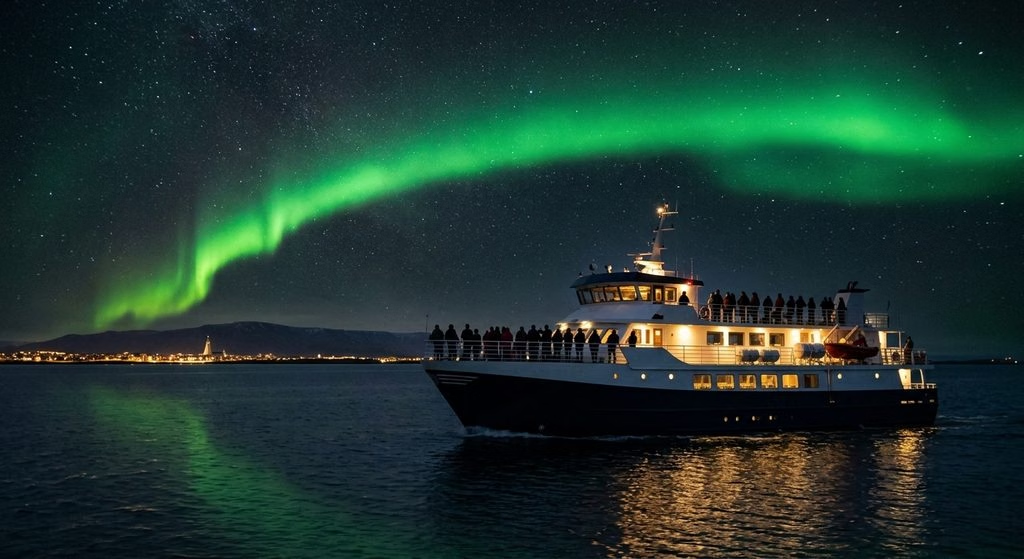
Tour listings look similar until you read the inclusions line by line. A higher price may reflect a smaller group, more guide time, or extra gear rather than better aurora odds. EastWest’s small-group tour, for example, lists hot chocolate, Icelandic pastries, and free photos when conditions allow. Special Tours lends warm overalls on its boat trip, and Elding’s boats have heated indoor cabins.
- Hot drinks and snacks: Hot chocolate is common on smaller tours, often with a pastry or cookie. Large coach tickets may cover transport and guiding only. On boats, drinks and snacks are often sold on board instead.
- Photography help: Some guides help with phone settings or take a portrait beneath the aurora. Confirm whether you receive edited files, a download link, or only camera advice. A “photo tour” may mean instruction, not a personal photo package.
- Warm gear: Thermal overalls sometimes come with premium minibus and boat trips. Gloves, hats, and waterproof boots usually remain your job. Ask about sizes before relying on a loaned suit.
- Pickup: Central Reykjavik pickup usually means a marked bus stop near your hotel, not the hotel door. Check the pickup point, start time, and vehicle name on your voucher. Missing the feeder bus can mean missing the whole tour.
- Guide and onboard features: Expect English-language guiding unless another language is listed. Wi-Fi, charging ports, restrooms, and wheelchair access vary by vehicle and vessel. Never assume they are included.
Extras can change the mood of your night. Smaller groups may add stargazing, local stories, or a quiet stop away from other vehicles. Boat tours trade roadside stops for open sea views and a heated cabin, though wind and motion make handheld photos harder.
Watch out for vague phrases such as “professional photos available.” “Available” can mean paid separately, shared only when conditions allow, or uploaded days later. Ask whether the service costs extra and how you receive the files.
Takeaway: Before you book a Reykjavik northern lights tour, check five things: drinks, warm gear, pickup point, photo delivery, and extra fees.
What If the Northern Lights Are Not Visible During the Tour?
A missed aurora rarely means a cash refund. The tour still ran for several hours and covered transport and guiding. Instead, most operators offer a free second attempt when clouds or weak solar activity hide the lights.
No single policy covers every northern lights tour from Reykjavik, so read the written terms for your exact ticket. Reykjavik Excursions, for example, states that it does not refund a tour that runs without a sighting. EastWest offers a free retry, subject to space. Elding gives you a free return ticket for another sailing.
- The tour runs, but you see no aurora: You usually get another departure at no extra charge. Your new seat depends on space, and upgrades may not carry over.
- Your departure is canceled for weather: You can usually move to another date. A refund may apply when the tour cannot run, but get that confirmation in writing. Some boat operators switch you to a bus tour when it is too windy to sail.
- You cancel or miss pickup: Free retry protection normally does not apply. Arriving late at a Reykjavik pickup stop can count as a no-show.
- You see only a faint aurora: Your guide may count that as a sighting, even when your camera picks up more color than your eyes. “No lights” is not always defined as “no bright green display.”
Watch out for retry deadlines. A replacement ticket may expire after a set period or at the end of the aurora season. You may also need to contact the booking desk yourself rather than simply joining the next bus.
When you plan a northern lights tour from Reykjavik, keep your final two evenings open if you can. A free retry has little value when your first tour falls on your last night, especially before an early flight. Boat retries can also be harder to use when wind keeps boats in the harbor for several nights.
Save your booking email, no-sighting voucher, and any cancellation notice. With your Telekonek data running on the drive back, you can message the booking desk and claim the next free seat before other guests do.
If a refund is approved, check that it returns to your original card. Your statement may show a slightly different amount in your home currency, because the Icelandic króna rate can move between purchase and refund. A foreign transaction fee may also stay unless your card issuer reverses it.
Takeaway: Book your first attempt early in your stay, and confirm the retry deadline, sighting definition, and refund terms before paying.
What Should You Bring or Wear for a Northern Lights Tour?
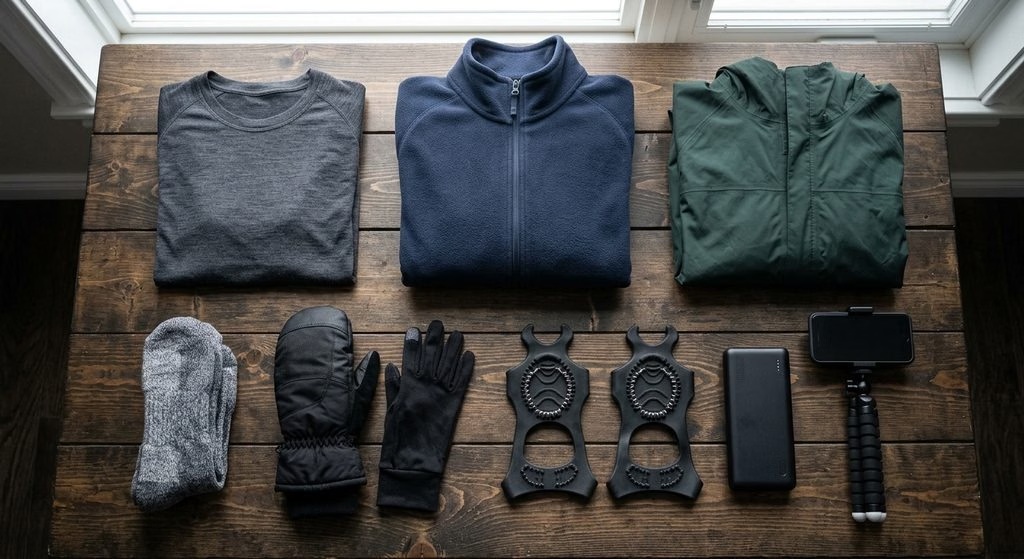
On a northern lights tour from Reykjavik, dress for standing still, not for the short walk from your hotel. You may spend 20–40 minutes outside at one viewing stop. Wind across open lava fields can make mild temperatures feel sharply colder.
Use three layers on your upper body. Start with a wool or synthetic thermal shirt, add fleece or light down, then wear a waterproof shell. Avoid cotton as your base layer, because it holds sweat and chills quickly.
- Warm base layers: Pack thermal leggings and a long-sleeve top. Merino wool stays warm without feeling bulky.
- Insulated middle layer: Choose fleece, wool, or a packable down jacket. You can take it off inside a heated coach.
- Windproof outer layer: Wear a hooded waterproof jacket and waterproof pants. A thick city coat may be warm but still let wind through.
- Waterproof boots: Choose boots with deep tread and room for thick socks. Tight boots reduce circulation and make your toes colder.
- Wool socks: Wear one warm pair rather than several tight pairs. Pack a dry spare pair if rain is forecast.
- Hat, gloves, and neck gaiter: Thin touchscreen gloves under insulated mittens let you adjust your phone without bare hands.
Boat tours need extra wind protection, because the open deck feels colder than inland stops. Wear your waterproof layers even when the Reykjavik forecast shows no rain. Sea spray and wind can soak jeans surprisingly fast.
Bring a charged phone, a power bank, and a short charging cable. Cold drains batteries faster, so keep your phone in an inner pocket between photos. Save your ticket and pickup stop offline in case the signal drops at a viewing spot.
For phone photos, pack a small tripod and use night mode. A remote shutter or two-second timer reduces blur. Keep spare camera batteries close to your body, not in an outside bag pocket.
Watch out for icy ground. Smooth sneakers and fashion boots slide easily at roadside pull-offs. Small slip-on ice grips help, but take them off before you step onto a coach or boat, because metal spikes damage floors.
Add lip balm, hand warmers, any prescribed medicine, and a small water bottle. Skip a large backpack on a full coach, since legroom and overhead space may be limited.
Takeaway: Wear thermal layers, waterproof outerwear, grippy boots, and full hand and head protection, even when Reykjavik itself feels comfortable.
What a Typical Tour Night Looks Like
A real northern lights tour from Reykjavik rarely shows a perfect green sky from start to finish. You may leave Reykjavik under thick cloud, then drive toward a narrow clear patch. Your guide may change direction several times as coastal weather shifts.
That uncertainty can feel frustrating in the first hour. Yet a sudden break above a dark lava field can turn a quiet roadside stop into the best moment of your trip. Expect more waiting and sky-watching than nonstop action.
- The “gray cloud” surprise: Your first aurora may look pale gray rather than bright green. Your phone camera gathers more light, so night mode can show color before your eyes adjust. Skip the flash, brace your phone, and hold still for several seconds.
- The weather-chasing evening: Your planned viewing area can change after departure. That is usually a good sign, because your guide is searching for clearer skies. Do not judge the night by the first stop.
- The crowded viewing stop: Several tour vehicles may reach the same clear area. When your guide allows it, walk a short, safe distance from headlights and phone screens. Your night vision improves after roughly 15–20 minutes away from bright light.
- The late return: A good Reykjavik northern lights tour may finish later than planned when the guide follows an active display. Keep the next morning flexible.
The tour style shapes your night, too. On a large coach, you get a warm seat but may wait while dozens of passengers board. On a minibus, conversation feels easier, and photography help can feel more personal.
A boat tour creates a different story. Reykjavik’s skyline fades behind you, but wind and rolling water can pull your attention from the sky. Dress for the open deck, not the heated cabin, so you can stay outside when the lights appear.
Watch out for exaggerated photos. Long camera exposures show stronger greens and purples than you see unaided. A faint arc that slowly brightens is still a real aurora, not a failed night.
Takeaway: Expect waiting, route changes, faint early color, and one possible burst that makes the cold worthwhile.
How to Book a Northern Lights Tour From Reykjavik
Book your northern lights tour from Reykjavik for your first or second night in Iceland. That leaves open evenings for another attempt if weather blocks the view. Waiting until your final night removes that flexibility.
Start with the operators’ own pages, such as Reykjavik Excursions, EastWest, Elding, or Special Tours. Then compare them with booking platforms, because the same tour can carry very different prices. Check the same details on each listing rather than choosing from the headline photo. Aurora images show what is possible, not what your departure guarantees.
- Confirm the pickup point: Large buses cannot enter much of central Reykjavik. Your pickup may be at a numbered bus stop instead of your hotel door. Match the stop name on your ticket with your hotel’s address before paying.
- Check the group size: “Small group” should come with an actual passenger limit. A minibus usually boards faster, while a coach often gives you more indoor space.
- Read the duration carefully: A tour sold as three or four hours can return later when guides chase clearer skies. Avoid an early flight or prepaid morning activity the next day.
- Review every extra: Check whether warm clothing, drinks, photos, and hotel transfers are included. A cheaper fare can cost more once you add optional items.
- Save the exact terms: Screenshot the cancellation, weather, and retry rules. Policies can differ by ticket type, even within one operator.
For a better deal, check weekday departures on the operator’s own booking calendar. Discounts may appear on selected dates, but do not trade away flexible terms to save a small amount. In Iceland’s fast-changing weather, the ability to move your booking matters more than a discount.
If you pay with a card from home, watch the payment screen. It may show an estimated amount in your currency while the final charge settles in Icelandic króna. If you get the choice, paying in króna usually avoids the merchant’s exchange markup. Your card may still add a foreign transaction fee.
Watch out for time and pickup mistakes. Your confirmation uses Reykjavik local time, and Iceland does not change its clocks for daylight saving time. Add the departure to your phone calendar in the Reykjavik time zone. Then arrive at the pickup stop at least 15 minutes early.
Download the voucher and save the operator’s message thread before you leave your hotel. Mobile data covers a late pickup update, but an offline copy protects you in concrete hotel lobbies and at remote viewing stops.
Takeaway: Reserve an early-trip departure, verify the exact pickup stop, pay in króna when offered, and screenshot every booking term.
How Do You Stay Connected on a Northern Lights Tour?
Your phone signal may weaken once your Reykjavik northern lights tour leaves the city’s bright streets. Viewing stops often sit beside lava fields, coastal roads, or open countryside. Coverage can drop behind hills or in bad weather.
Set up your Telekonek eSIM at home, before you fly. An eSIM is a digital SIM, so there is no physical card to swap. You install it once, then top up for each destination across 200+ countries. For Iceland, you can choose a fixed amount of data or an unlimited plan. If Iceland is one stop on a longer trip, the Europe regional plan covers it along with 34 other countries. The Europe eSIM guide explains how that works.
- Telekonek data: Use it for maps, weather updates, messages, and photo uploads. Turn on data roaming for the eSIM line after you land in Iceland.
- Your home number: Keep that line on for bank codes and important texts. Turn off cellular data switching, so your phone does not quietly use costly roaming on your home SIM.
- Hotel Wi-Fi: Use it for cloud backups and large video uploads. Do not depend on it once your evening pickup begins.
Not sure which switches to flip on arrival? This airplane mode landing routine walks you through setting your data line without triggering roaming charges.
For a five- to seven-day Iceland trip, 3–5 GB usually covers navigation, WhatsApp, email, and moderate photo sharing. Choose more data if you plan to upload video. A few short HD clips can use hundreds of megabytes, and live video drains both data and battery quickly.
Before pickup, screenshot your ticket, bus-stop number, guide’s contact details, and hotel address. Download Reykjavik and the surrounding region in Google Maps for offline use. Bookmark the Met Office aurora forecast as well, though your guide may change direction as cloud cover moves.
Reliable data also matters when you want to share your location. Share your live location through WhatsApp with someone at home, then stop sharing after the tour. This WhatsApp roaming and eSIM guide shows how to keep messages off the wrong mobile line.
Watch out for cold-battery failure. Low temperatures can shut down a phone that still shows 20% charge. Keep it inside your coat with a power bank, and switch on low-power mode before the first viewing stop.
Take your photos first and upload them after you return to the warm vehicle. A weak signal can stall an upload, heat your phone, and waste the battery you need for night mode.
Takeaway: Install your Telekonek eSIM before departure, save tour details offline, and keep your phone warm at every viewing stop.
Frequently Asked Questions About Northern Lights Tours From Reykjavik
How much does a northern lights tour from Reykjavik cost?
Large bus tours start at about 9,000–10,000 ISK per person. Small-group minibus tours run about 13,000–21,000 ISK, and boat trips about 13,500–14,500 ISK. Private tours cost roughly 150,000–260,000 ISK for the whole group.
What time do tours leave?
Most road tours leave between about 8:30 p.m. and 10 p.m., and boat trips often sail around 9 p.m. Read Icelandic times carefully: 21:00 means 9 p.m. Pickup may start up to 30 minutes before the listed departure, so keep the whole evening free.
How long is a northern lights tour from Reykjavik?
Road tours usually last 3.5–4 hours, and boat trips 2–3 hours. A tour can run longer when your guide drives further to find a clear sky. Use the restroom before boarding, since stops outside town have few facilities.
Can you see the northern lights from Reykjavik city center?
Sometimes, on strong nights. City lights wash out faint displays, so darker spots such as the Grótta lighthouse on the edge of town work better. A tour takes you much further from light pollution.
Can a northern lights tour from Reykjavik be canceled at short notice?
Yes. Unsafe roads, strong wind, heavy cloud, or rough seas can stop a departure. Keep your phone reachable during the afternoon, and check the email address you booked with.
Will you get a refund after a cancellation?
It depends on who cancels and which fare you bought. A departure the operator cancels may qualify for a new date or a refund. A tour that runs without visible aurora usually earns only another attempt.
What gear do you really need?
You need warm waterproof clothing, sturdy shoes, gloves, and a charged phone. You usually do not need specialist camera gear or hiking equipment. Thin touchscreen gloves under warmer mittens let you adjust settings without exposing your fingers.
Will the aurora look as bright as Reykjavik northern lights tour photos?
Not always. Your eyes may first see a pale arch, while your phone captures stronger green through a longer exposure. Give your vision several minutes to adjust, lower your screen brightness, and avoid using a flash near other photographers.
Can you rely on an aurora forecast?
Treat a forecast as a clue, not a promise. A clear sky above your viewing spot matters as much as solar activity. A modest forecast with open sky can beat a strong forecast hidden behind clouds.
Takeaway: Keep one backup evening free and save your cancellation terms offline. Then set up your Telekonek Iceland eSIM before you fly, so pickup changes reach you wherever the tour goes.