
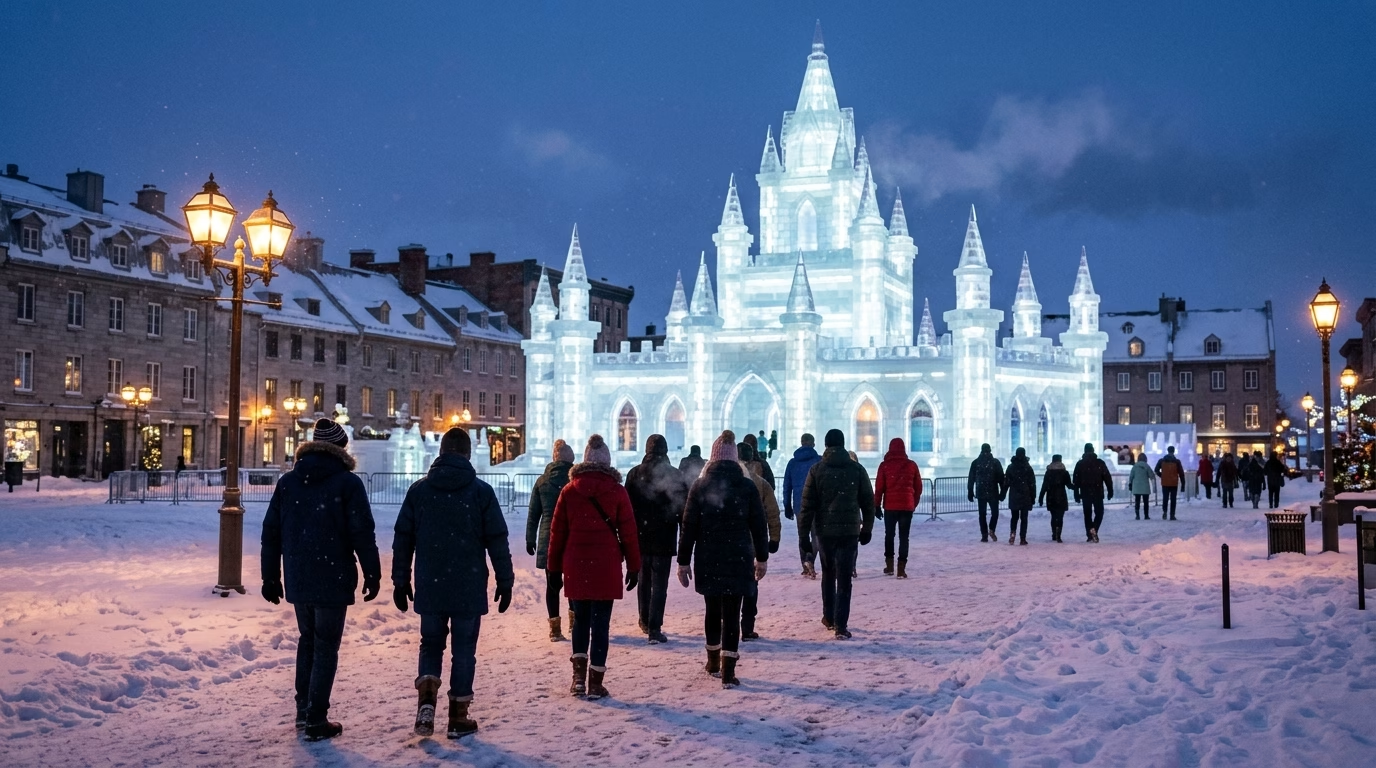
The winter carnival in Quebec returns from February 5 to 14, 2027. For ten days, Québec City turns its coldest stretch of the year into one long outdoor party. You get an ice palace, two night parades, snow sculptures, live music, and a snowman host named Bonhomme. This guide covers the dates, the pass you need, where to stay, what to pack, and how to keep your phone working in the cold. Sort your data before you fly with a Telekonek Canada eSIM, and you land ready to go.
Key Takeaways
- Dates: The 73rd Carnaval de Québec runs Friday, February 5 to Sunday, February 14, 2027.
- Cost: Your pass is the Effigy. It costs C$29 plus tax in presale until January 17, 2027, then C$39 plus tax. Kids 12 and under do not need one.
- Headline events: Night parades are listed for Saturday, February 6 (Lower Town) and Saturday, February 13 (Upper Town). The ice canoe race is on Sunday, February 7.
- Where to stay: Parliament Hill and the upper part of Old Québec put you closest to the main sites.
- Cold: Plan for about -5°C (23°F) on a sunny afternoon and -15°C to -25°C (5°F to -13°F) on parade nights.
- Data: Install your Telekonek eSIM at home so maps, tickets, and weather alerts work the moment you arrive.
What Is the Winter Carnival in Quebec and Why Is It Famous?
The winter carnival in Quebec is known locally as the Carnaval de Québec. It is one of the largest winter festivals in the world and draws close to 400,000 visitors a year. Instead of hiding from snow and subzero air, the whole city heads outside.
The first carnival took place in 1894. It ran on and off for decades, then came back for good in 1955. It has been held every year since. That same year, Bonhomme Carnaval made his first appearance. He is a seven-foot snowman in a red cap and a woven arrow sash, and he hosts the entire event.
The setting does a lot of the work. Old Québec has stone walls, steep lanes, and a skyline topped by the Château Frontenac. Under fresh snow, it looks like a film set. The carnival is not a staged show built for tourists, though. You are joining a French-Canadian city that treats winter as part of who it is.
- For families: snow slides, games, sugar shack stands, and daytime shows.
- For couples and friends: lit-up streets, free outdoor concerts with your pass, and long dinners in Old Québec.
- For first-time winter travelers: a ready-made program, so you do not have to invent your own cold-weather plan.
Takeaway: The carnival is famous because it makes deep winter the main event, with Bonhomme, an ice palace, and Old Québec as the backdrop.
When Is the Winter Carnival in Quebec in 2027?
The 2027 edition runs from Friday, February 5 to Sunday, February 14. That gives you ten days and two full weekends. The 2026 carnival ran February 6 to 15, so the timing barely moves from year to year.
Here is what is on the calendar so far:
- February 5 to 14: Carnival sites open daily, with Bonhomme’s Ice Palace, snow and ice sculptures, slides, and family activities.
- February 5 to 13: Musical evenings. The carnival has announced 27 shows across nine nights and three stages, all included with the Effigy.
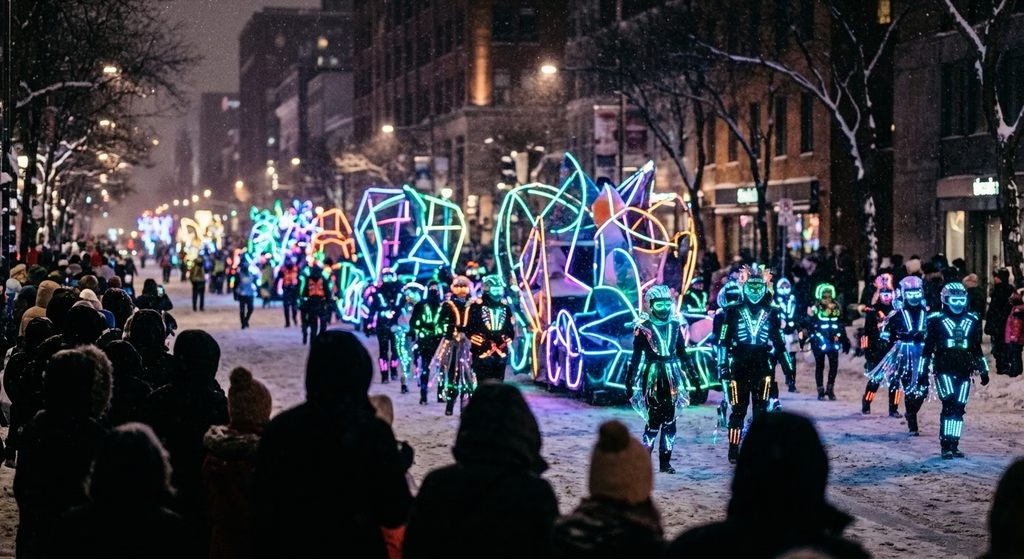
- Saturday, February 6, 5:30 p.m.: Lower Town night parade in the Limoilou district. It follows 3e Avenue from 1re Rue to 18e Rue.
- Sunday, February 7, from about 12:30 p.m.: Ice canoe race on the St. Lawrence River. Watch for free from Pointe-à-Carcy, wharfs 19 and 21, in the Port of Québec.
- Saturday, February 13, 7:00 p.m.: Upper Town night parade. It runs along Grande Allée from Avenue des Érables and ends near the Parliament building.
Each parade lasts about 30 minutes, but you will stand outside far longer than that. Plan one big evening event per night. Road closures, crowds, and cold make it hard to stack a parade, a dinner booking, and a concert.
The full day-by-day program usually lands closer to the event. Check the Québec City tourism listing for the carnival before you lock in parade nights. Outdoor events can also shift with wind or a thaw, so recheck on the day.
Québec City runs on Eastern Time, the same as New York and Toronto. The sun sets at about 5 p.m. in early February. A 5:30 p.m. parade is already a night event, so dress for the dark, not the afternoon.
Takeaway: Build your trip around one weekend and one parade night, then leave a spare half-day for weather.
How Much Does the Quebec Winter Carnival Cost?
You do not buy a daily ticket. Your pass is the Effigy, a small Bonhomme figure that clips to your coat. One Effigy covers the carnival sites and the musical evenings for all ten days.
- Presale price: C$29 plus tax until January 17, 2027. With Quebec sales taxes, that is about C$33.
- Regular price: C$39 plus tax from January 18 to February 14, 2027. That comes to about C$45.
- Children: Kids aged 12 and under do not need an Effigy.
- Extras: Each Effigy comes with a booklet of 14 discount coupons for local businesses.
You can buy it online, at participating Brunet pharmacies in Quebec, or at the carnival sites during the event. Online orders carry an added fee. Current prices and sales points are on the official Effigy page.
Not everything needs the pass. You can watch both night parades and the ice canoe race for free. Walking past the sculptures and through Old Québec costs nothing. The Effigy matters once you want to enter the sites, ride the slides, or see the shows.
Your bigger costs are flights, hotels, and food. Prices in Québec City are in Canadian dollars. If your card bills in another currency, your final charge moves with the exchange rate. Some cards also add a foreign transaction fee, so pick one that does not.
Watch out: hotel packages that bundle rooms with carnival access are common. Read what is included before you pay. A “from” price is often per person, based on two sharing, before taxes. Compare it against booking a flexible room and buying two Effigies yourself.
Takeaway: Buy your Effigy before January 17 to save C$10 per adult, and budget most of your money for the hotel.
Where Should You Stay During the Carnival?
The main carnival sites sit in the upper town. Listings place them at Place de l’Assemblée-Nationale, in front of the Parliament building, and at Place George-V next door. Ice and snow sculptures line Grande Allée nearby. The city’s tourism office suggests staying around Parliament Hill, inside the old walls, or in the Montcalm and Saint-Jean-Baptiste districts.
February is peak winter pricing, and both carnival weekends sell out early. The ranges below are rough nightly estimates in Canadian dollars before taxes. Midweek nights are often much cheaper than Fridays and Saturdays, so check live rates for your dates.
- Delta Hotels by Marriott Québec — about C$190–C$350. A modern hotel on Parliament Hill, a short walk from the Ice Palace area and Grande Allée. This is the practical pick if you want the shortest cold walk home.
- Hôtel Palace Royal — about C$180–C$320. Just outside the Saint-Jean Gate, with larger rooms and an indoor pool. It suits families who want elevators and easy access to restaurants.
- Hôtel Manoir Victoria — about C$220–C$400. Inside the walls near Rue Saint-Jean. The indoor pool and sauna earn their keep after hours in the wind.
- Fairmont Le Château Frontenac — about C$350–C$800+. The landmark choice, with several restaurants and warm common areas. You pay for the address, and the walk to the carnival sites is around 15 minutes.
- Auberge Saint-Antoine — about C$300–C$550. A quiet, polished stay in the Old Port, close to the ice canoe race. Remember that the walk back up to the upper town is steep and can be icy.
Watch out for: Old Québec looks small on a map, but it is built on a cliff. A room in the lower town means a slippery climb after a late show. The funicular links the lower town to Dufferin Terrace and saves you the hill.
Getting around is mostly on foot. Street parking fills fast on evenings and weekends, so the city recommends public transit. Paid parking is available at Place D’Youville and the Marie-Guyart Building. Keep your hotel address and a transit route saved on your phone, and use your Telekonek data to check for closures after a heavy snowfall.
Takeaway: For the easiest winter stay, book near Parliament Hill or the Saint-Jean Gate, and book early.
What Should You Pack for the Cold?
Cold at the winter carnival in Quebec feels different from cold at home. You stand still for parades, wait in outdoor lines, and walk on packed snow. A sunny afternoon sits near -5°C (23°F). Evenings drop to -10°C to -15°C (14°F to 5°F). Parade nights and windy spots by the river can hit -25°C (-13°F).
Build your outfit in three layers. Avoid cotton next to your skin. Once cotton gets damp from sweat or snow, it stays cold.
- Base layer: Merino wool or synthetic top and leggings. Bring two sets for a multi-day trip.
- Mid-layer: Fleece, a wool sweater, or a light insulated jacket. A zip helps when shops and restaurants feel too warm.
- Outer layer: A waterproof, windproof parka that covers your hips, with a hood you can tighten.
Your boots matter most. Choose insulated, waterproof winter boots with deep rubber tread. Leave room for thick wool socks, since tight boots cut circulation and chill your toes faster. Removable ice cleats add grip on steep sidewalks. Take them off before you walk into hotels and restaurants.
Bring two pairs of gloves. Wear a warm insulated pair for walking and thin liners for photos and maps. Add a neck gaiter that can cover your cheeks and a toque, the Canadian word for a knit winter hat.
- Useful extras: lip balm, hand cream, sunglasses for snow glare, hand warmers, and a small daypack.
- For children: spare mittens and socks. Wet mittens end outdoor fun faster than anything else.
- Skip: fashion sneakers, thin leggings worn as pants, and jeans without a thermal layer underneath.
Watch out for the indoor-outdoor cycle. Cafés and hotels run warm. Open your parka and take off your hat as soon as you step inside. If you sweat indoors, you will freeze when you go back out.
Cold also drains your phone. Keep it in an inside pocket with a small power bank, not in an outer bag.
Takeaway: Wear wool or synthetic layers, insulated boots with real tread, and keep a dry spare pair of gloves ready.
What Are the Must-See Attractions at the Carnival?
Bonhomme’s Ice Palace is the heart of the event. A new palace is built from blocks of ice every year, usually in front of the Parliament building. It is also your best chance to meet Bonhomme. Go in daylight to see the carving and the blue-white detail. Come back after sunset for the lights. Allow at least 20 minutes inside.
The night parades are the other headline. Expect lit floats, drum lines, dancers, and circus acts moving through the snow. The Lower Town parade is the more local, neighborhood one. The Upper Town parade runs along Grande Allée and finishes near the palace. Both are free to watch.
- For the best view: arrive 30 to 45 minutes early. Crowds are thickest at the obvious corners and thin out a few hundred meters along the route.
- For families: stand near an easy exit, not in the densest part of the crowd.
- For photos: use night mode, wipe snow off your lens, and warm your phone in a pocket between shots.
The ice canoe race is the strangest sport you will see all year. Teams paddle across open water, drag their canoes over ice floes, then jump back in. In 2027 it takes place on Sunday, February 7. You can watch for free from Pointe-à-Carcy in the Port of Québec. The carnival also sells a VIP spot on a moored ferry with heated decks and an open bar, listed at about C$86 plus tax.
The snow bath is exactly what it sounds like. Brave people in swimsuits roll in the snow with Bonhomme. Watching is free, and a lot warmer.
Snow and ice sculptures line Grande Allée and the main sites. Artists carve them from huge blocks during the event, so the same piece looks different on day two and day eight. Treat this as a slow walk, not a checklist.
The musical evenings run on three outdoor stages. The 2027 lineup includes well-known Québec acts such as Marie-Mai and FouKi. Every show is included with your Effigy.
Watch out for: palace hours, site access, and showtimes can change with the weather. Keep the program open on your phone with Telekonek data, not an old screenshot.
Takeaway: See the Ice Palace after dark, pick one night parade, and use daylight for the sculptures and the canoe race.
What Should You Eat and Drink at the Carnival?
Food is half the fun, and most of it is built to be eaten with mittens on.
Start with maple taffy on snow, called tire d’érable. Hot maple syrup is poured over clean packed snow, then rolled onto a wooden stick. You will find it at the sugar shack stands on the carnival sites.
Try caribou, the carnival’s signature drink. It is a hot mix of red wine and strong spirits, often sweetened with maple syrup. Recipes vary, so one cup can taste mild and the next can be very strong. Eat first, and go slowly in the cold.
- Poutine: Fries, fresh cheese curds, and gravy. Expect about C$9 for a small one at a local fast-food counter, up to around C$20 for a loaded version. Eat it right away, before the curds cool.
- Tourtière: A spiced meat pie, usually pork and beef. It makes a good sit-down lunch when you need to warm up.
- Pea soup: Thick yellow pea soup with pork. It is cheap, hot, and more useful between events than another sweet snack.
- Pouding chômeur: A soft cake baked in maple or brown-sugar sauce. It is rich, so share one.
- BeaverTails: Fried dough with cinnamon sugar, sold hot at winter stands across the city.
For a traditional sit-down meal, Aux Anciens Canadiens serves classic Québécois dishes in one of the city’s oldest houses, on Rue Saint-Louis. For something casual, Buffet de l’Antiquaire on Rue Saint-Paul in the Old Port has served home-style breakfasts, meat pie, and pea soup since 1976. Menu prices do not include sales tax, which adds about 15% to your bill. Book ahead on parade nights, since tables near the route fill early.
Watch out: menus are often in French first. “Sirop d’érable” means real maple syrup. A product labeled “maple-flavored” may not contain any. A quick translation on your phone settles it.
Takeaway: Pair one maple treat outside with a hot bowl of pea soup or tourtière inside, and save the caribou for after you have eaten.
How Do You Stay Safe and Warm at the Carnival?
The carnival is a friendly, well-run public event. Your main risks are the cold, the ice underfoot, and the crowds on parade nights.
- Take indoor breaks: Warm up every 45 to 60 minutes. Do not wait until your fingers hurt or your feet go numb.
- Watch your footing: Stone streets and stairs get slick under packed snow. Wear real tread and take the hills slowly.
- Keep valuables close: Use a zipped bag under your outer layer in dense crowds. Leave your passport in the hotel safe.
- Set a meeting point: Darkness, hats, and scarves make everyone look alike. Agree on a landmark before you enter a busy area.
- Know the signs of frostbite: Skin that turns pale, waxy, or numb needs warmth right away. Get indoors.
For health advice that is not an emergency, call 811, Quebec’s free nurse line. Call 911 for anything urgent, such as a bad fall on ice or trouble breathing.
Check that your travel insurance covers medical care in Canada before you leave. Visitors pay for hospital treatment, and the bills are high. Save your insurer’s assistance number and your hotel address offline.
A working phone is part of your safety kit. With Telekonek data running, you can check weather warnings, share your location with your group, and find the nearest warm café in seconds.
Takeaway: Warm up often, walk carefully, and keep your phone charged and connected.
How Does the Quebec Winter Carnival Compare to Other Winter Festivals?
The winter carnival in Quebec feels like a citywide party, not only an ice display. You get food, parades, music, and ice architecture within walking distance of a historic center. That makes it an easy fit for a long weekend.
- Winterlude, Ottawa: Known for skating on the Rideau Canal and family activities. Choose Ottawa if skating is your main goal. Choose Québec City for atmosphere, parades, and evenings in the old town. You can read about both in this guide to winter events and festivals in Canada.
- Sapporo Snow Festival, Japan: The pick for huge, finely detailed snow sculptures. Québec City is the more social, street-party experience. If Japan is on your list, see the Sapporo Snow Festival guide.
- Harbin Ice and Snow Festival, China: Built around giant lit ice buildings and extreme cold. Its scale is hard to match, but the weather is harsher. Québec City gives you spectacle plus cafés and easy indoor breaks.
- Saint Paul Winter Carnival, Minnesota: A proud local event with parades and a Midwestern feel. Québec City adds a walled old town, French-Canadian food, and river views.
The trade-off is simple. Québec City does not try to beat Harbin on size or Sapporo on sculpture detail. It blends a real historic city with festival energy. You spend the afternoon outside, warm up over a proper meal, then head back out for the lights.
Takeaway: Choose Québec City when you want a compact, culture-rich winter festival you can enjoy on foot.
How Do You Stay Connected at the Winter Carnival in Quebec?
Mobile data makes the winter carnival in Quebec much easier. You will use it to check the day’s program, find your group after a parade, translate a menu, and call a ride when the cold wins.
Public Wi-Fi is not a plan. Hotel Wi-Fi is fine for big downloads. Café networks are slow, need repeated sign-ins, and vanish the moment you step outside. That is exactly when you need a map.
Your Telekonek eSIM solves this before you leave home. An eSIM is a digital SIM, so there is no plastic card and no shop to find after you land. Your data connects on major Canadian partner networks, which cover Québec City well. Telekonek plans work in 200+ countries, so the same setup follows you if Canada is one stop on a longer trip.
Set it up in four steps:
- Check your phone. It must support eSIM and be unlocked, meaning it can use a network other than the one that sold it. Most recent iPhone, Google Pixel, and Samsung Galaxy models qualify.
- Install at home on Wi-Fi. On iPhone, go to Settings → Cellular → Add eSIM. On Android, go to Settings → Network & internet → SIMs → Add eSIM. Scan your QR code.
- Label the line “Telekonek Canada.” A clear name stops mix-ups when you are tired.
- Switch on when you land. Set Telekonek as your mobile data line and turn data roaming on for that line. Turn data roaming off on your home SIM to avoid surprise charges.
You can keep your home SIM active for calls and bank texts while your data runs on Telekonek. For a deeper walkthrough, read the guide to using an eSIM for Canada winter travel.
A few habits stretch your data and your battery:
- Download an offline map of Québec City before you go out.
- Screenshot your Effigy receipt, hotel address, and dinner bookings.
- Pause cloud photo backups and video autoplay until you are back on hotel Wi-Fi.
- Carry a 10,000 mAh power bank in an inside pocket, where it stays warm.
If you are connecting through Toronto, the Toronto Pearson winter travel guide helps you plan for delays between flights.
Takeaway: Install your Telekonek eSIM before departure, keep your home line off data, and save offline backups for when cold batteries act up.
Frequently Asked Questions About the Winter Carnival in Quebec
Is the Quebec Winter Carnival free?
Partly. The night parades, the ice canoe race, the street sculptures, and Old Québec itself are free to enjoy. You need an Effigy to enter the carnival sites and see the shows. It costs C$29 plus tax in presale or C$39 plus tax at the regular price. Children 12 and under get in without one.
Where is the Quebec Winter Carnival held?
It takes place in Québec City, in the province of Quebec, Canada. The main sites are in the upper town around the Parliament building, Place George-V, and Grande Allée. One parade runs through the Limoilou district in the lower town, and the canoe race is at the port.
How long does the winter carnival in Quebec last?
It lasts ten days and covers two weekends. In 2027, it opens on Friday, February 5 and closes on Sunday, February 14.
How many days do you need?
Two nights is enough for a focused visit. That gives you one full day on the sites, one parade or concert night, and a half-day in Old Québec. Add a third night if you are traveling with children or want a weather backup.
Is the carnival good for kids?
Yes, with realistic pacing. Snow slides, games, and meeting Bonhomme work well for school-age children. Plan one main activity at a time and a warm-up stop every 45 to 60 minutes. A stroller with small wheels struggles on packed snow and steep streets, so a sled or carrier is easier.
What can you do between carnival activities?
Walk Rue du Petit-Champlain for shops and winter window displays. Ride the toboggan slide on Dufferin Terrace beside the Château Frontenac. For an indoor reset, visit the Musée de la civilisation near Place-Royale or settle into a café on Rue Saint-Jean. A long lunch is not wasted time in February. It dries your gloves and charges your phone.
Is the winter carnival in Quebec worth it?
If you like the idea of a city that celebrates winter out loud, yes. Few festivals put this much within a short walk of your hotel. Come dressed for the cold and you will have a great time. Come underdressed and you will spend the trip indoors.
Ready to plan your trip? Get your Telekonek eSIM for Canada before you fly, and step off the plane with your maps, tickets, and weather alerts already working.