
Your 7-Day Japan Cherry Blossom Itinerary, Day by Day
This Japan cherry blossom itinerary uses Tokyo and Kyoto as your two bases, with Nara or Osaka as an easy day trip. You see several bloom areas without losing hours to hotel changes. Exact 2027 peak dates are not confirmed yet, so treat this as a flexible route, not a fixed blossom calendar. Check the latest forecast before you lock in each day.
A warm or cold week can shift the best viewing area, so your Japan cherry blossom itinerary may need to move by a day. Install a Telekonek Japan eSIM before you fly so live bloom reports, maps, and train platforms are on your phone from the moment you land.
- Day 1: Arrive in Tokyo. Keep your first afternoon light. If you land early, walk the Meguro River or Shinjuku Gyoen, then eat near Shinjuku Station. Shinjuku Gyoen closes in the late afternoon and bans alcohol, so check the day’s hours first. Save major sightseeing for tomorrow, since jet lag and airport queues can turn an ambitious arrival day into a rushed one.
- Day 2: Central Tokyo blossoms. Start at Chidorigafuchi beside the Imperial Palace moat, then walk into neighboring Kitanomaru Park. Finish with coffee in the bookshop streets of Jimbocho. Go early: this area gets packed by late morning, especially on clear weekends.
- Day 3: Old Tokyo, then an evening train west. Walk Ueno Park early, then wander Yanaka’s quieter lanes for a calmer break. Take an evening shinkansen to Kyoto and sleep there. That way you don’t spend a prime blossom morning in transit.
- Day 4: Eastern Kyoto. Start early on the Philosopher’s Path while it is still quiet, then visit Nanzen-ji. Save Gion for late afternoon into evening, when the old lanes light up and the day-trip crowds thin out.
- Day 5: Kyoto’s classic sights. See Kiyomizu-dera early, then head to Maruyama Park and the Kamo River. Use this as your flexible weather day. Rain can bring petals down fast, but it also cuts crowds and gives temple grounds a quieter feel.
- Day 6: Nara or Osaka day trip. Choose Nara for park walks, temples, and a slower day among deer and old stone paths. Choose Osaka for Osaka Castle Park and a louder, food-focused evening in Dotonbori. Don’t try to do both; the travel time and crowds make the day feel thin.
- Day 7: Return to Tokyo or fly from Kansai. If your flight leaves Tokyo, take an early train back and allow a generous airport buffer. If you fly from Kansai, use your last morning for Nishiki Market or a short Kyoto walk.
Load maps, rail platforms, and bloom updates before you leave your hotel each morning. Is Japan one stop on a longer trip? The same Telekonek eSIM works in 200+ countries, so you just top up for the next destination.
Want more time in the capital before heading west? Borrow a day or two from this 3-day Tokyo itinerary and trim a Kyoto day to match.
Takeaway: Spend two nights in Tokyo and four in Kyoto, then use one flexible day for Nara or Osaka as the 2027 bloom forecast develops.
When Should You Plan Your Visit for the 2027 Cherry Blossoms?
Exact 2027 blossom dates are not confirmed yet. Sakura timing depends on winter cold and on late-winter and early-spring temperatures. A warm spell can bring flowering forward, while a cold stretch can delay it. In most years, Tokyo and Kyoto reach full bloom in late March or early April. Build your Japan cherry blossom itinerary around flexible bases, not one fixed “peak” day.
Give yourself several possible viewing days in each city. That way, an early or late bloom doesn’t ruin the trip. Your Tokyo days can move around easily, while Kyoto, Osaka, and Nara work best as a second cluster later in the week.
- Kaika means the first blossoms have opened. Parks can look patchy, but crowds are often lighter.
- Mankai means full bloom. This is the classic pale-pink canopy stage, and the busiest period.
- Falling petals can be just as beautiful. A light wind creates the famous “sakura snow” effect, often a few days after peak.
Check the forecast when you book, again about two weeks before you fly, and every morning once you arrive. For city-by-city updates, search the Japanese terms 桜 開花予想 (sakura flowering forecast) and 満開予想 (full-bloom forecast). Use the forecast to decide which part of your route gets priority. Don’t try to force every stop into one perfect date.
The bloom moves from south to north, so a peak you miss in Tokyo can still be caught further up the country. This region-by-region guide to bloom times and festivals shows how the wave travels from Okinawa to Hokkaido.
Watch out: “full bloom” is not a seven-day guarantee. Rain, wind, and unusually warm afternoons can shorten the best viewing window. A forecast showing peak bloom during your stay is promising, not a promise. Book refundable hotels where you can, and hold off on booking every dinner, tour, and day trip until the forecast firms up.
Takeaway: Plan a flexible Tokyo–Kyoto week, then let the latest flowering and full-bloom forecast decide where each day of your Japan cherry blossom itinerary belongs.
Which Locations Are Must-Sees for Cherry Blossom Viewing?
Your Tokyo–Kyoto route covers the classic sights, but Japan’s most striking blossom scenes are not all in the big cities. For a stronger Japan cherry blossom itinerary, mix places with different tree types, landscapes, and bloom timing. Keep the forecast open on your phone so you can shift a day trip when one area hits its best stage.
- Kyoto: Philosopher’s Path, Maruyama Park, and Ninna-ji. Walk the canal-side Philosopher’s Path early, before the narrow trail fills with tour groups. Maruyama Park is at its best after dark, when its huge weeping cherry tree is lit up. Ninna-ji’s low, late-blooming Omuro-zakura trees put a sea of flowers at eye level. Don’t cram all three into one afternoon; pair Philosopher’s Path with nearby Ginkaku-ji, then visit Maruyama after dinner.
- Yoshino, Nara Prefecture. Mount Yoshino is Japan’s grandest blossom landscape. Its trees cover a mountainside in four zones: Shimo Senbon, Naka Senbon, Kami Senbon, and Oku Senbon. Each zone sits higher than the last, so the bloom works its way uphill and stretches the season. Watch out: slopes, queues, and limited road access make this a full-day trip, not a quick Nara add-on.
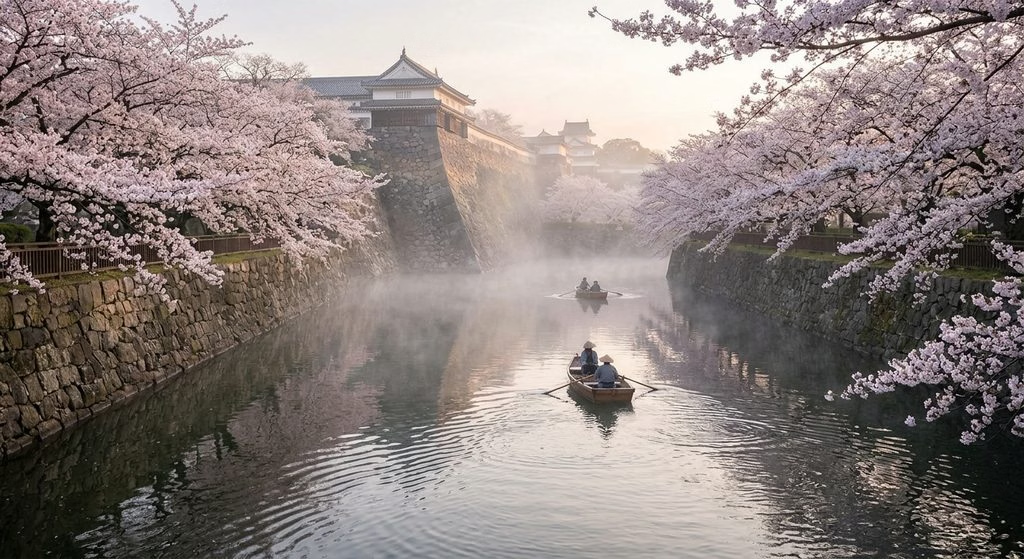
- Himeji Castle, Hyogo. Pale blossoms frame the white castle walls and moat, making this the clearest “postcard Japan” stop in Kansai. Arrive near opening time and photograph the outer grounds first. Then enter the castle before the staircases turn into slow lines. You take your shoes off inside and the stairs are steep, so wear shoes that slip on and off easily.
- Hirosaki Park, Aomori. For petals floating on water, head north to Hirosaki. Its castle moats, bridges, and snow-capped Mount Iwaki backdrop feel nothing like Kyoto’s temple gardens. It usually blooms in mid-to-late April, after Tokyo and Kansai. Treat it as a forecast-led alternative, not a fixed stop on a one-week route.
- Kakunodate, Akita. This former samurai town has long rows of weeping cherry trees beside preserved wooden residences. You get blossoms and historic streets in one compact walk, without Kyoto-sized crowds. Save the rail timetable and an offline map before you change trains in rural Tohoku, where connections are less frequent.
Takeaway: Kyoto’s spots slot straight into your core week. Swap your Day 6 trip for Himeji or Yoshino when the 2027 forecast favors them, and save the northern stops for a longer trip.
What Travel Tips Help You Get Between Cherry Blossom Sites?
Keep Tokyo and Kyoto as the two rail hubs of your Japan cherry blossom itinerary. That setup makes every site above easier to reach than changing hotels every night.
Within Tokyo, use an IC card such as Suica or PASMO for trains, subways, and most buses. You tap in and out instead of buying a ticket for every ride. It’s the simplest way to link Ueno, Chidorigafuchi, Shinjuku Gyoen, and the Meguro River in one day.
- Tokyo blossom days: Use local rail and subway lines. They run often, are easy to navigate in English, and are usually faster than a taxi once traffic builds near the parks.
- Tokyo to Kyoto: Take the Tokaido Shinkansen from Tokyo or Shinagawa to Kyoto Station. A Nozomi takes about 2 hours 15 minutes. Book a reserved seat in sakura season, especially if you have a suitcase.
- Kyoto sites: Combine walking with buses, the subway, and short taxi rides. The Philosopher’s Path, Maruyama Park, and Ninna-ji are not on one direct rail line.
- Osaka day trip: Ride a regular train from Kyoto instead of moving hotels. Osaka Castle Park is a short walk from the nearest station.
- Nara day trip: Take the train from Kyoto, then walk or catch a local bus toward Nara Park. Allow extra time for the final approach, since the park area is spread out.
Watch out: not every train from Kyoto to Nara or Osaka leaves from the same company’s platform. JR, Kintetsu, Keihan, and Hankyu all run services, and the fastest-looking route can involve a long walk between stations. Check the platform in a live route app shortly before you leave, using your Telekonek data, rather than relying on a screenshot from breakfast.
Taxis help when rain, tired legs, or late illuminations make public transport awkward. Use them for short hops in Kyoto, not between cities. Traffic around Maruyama Park on blossom evenings can turn a short ride into a slow, costly one.
Rail fares and pass rules can change before spring 2027, so confirm the current fare once your dates are set. For this route, point-to-point tickets usually beat a rail pass, because Tokyo to Kyoto and back is your only long intercity trip.
Takeaway: Use an IC card in the cities, reserve the Tokyo–Kyoto train, and keep live navigation open for Kyoto’s less direct blossom routes.
What Cultural Experiences Should You Add to Your Itinerary?
Cherry blossoms are the backdrop. The moments you remember most often happen between the viewing spots: a quiet tea room, a temple bell, a shared picnic under the trees. Add one cultural activity a day to your Japan cherry blossom itinerary rather than packing your schedule with tickets.
Start with hanami etiquette. Buy a bento, drinks, and a small ground sheet from a convenience store or department-store food hall. Then join a daytime picnic where it’s allowed. Keep your sheet compact, never shake branches for petals, and take all your trash with you. Public bins are scarce in blossom season, so carry a small bag for wrappers and cans.
Book a tea ceremony in Kyoto, ideally in Gion or near Higashiyama. You’ll learn how to hold the bowl, eat a seasonal sweet, and drink matcha in the right order. It’s a calm counterpoint to packed blossom paths. Choose a small-group session with an English explanation, not a rushed photo stop in costume.
Pair the ceremony with a walk through Ninenzaka and Sannenzaka, but go early. These lanes turn into slow-moving crowds by late morning. Your Telekonek eSIM helps you check same-day opening times and find a quieter lunch nearby instead of queuing in the busiest streets.
Learn the difference between shrine and temple manners. At a Shinto shrine, rinse your hands at the water pavilion and offer a small coin. Then bow twice, clap twice, make your wish silently, and bow once more. At a Buddhist temple, don’t clap. This small detail lets you take part respectfully instead of treating sacred sites as a photo set.
- Tokyo: Try a wagashi-making class. These delicate seasonal sweets often echo sakura petals and colors, so the class fits the trip better than a generic souvenir stop.
- Kyoto: Choose a short incense, calligraphy, or indigo-dye workshop. You leave with a skill or handmade item, not another mass-produced blossom trinket.
- Osaka: Eat at a counter-style okonomiyaki restaurant. Watching your meal cook on the hot plate is part of the fun; ask before adding sauces, since each place has its own style.
- Nara: Spend a few quiet minutes in a temple hall or museum after seeing the deer. Feeding deer crackers is fun, but it is not the cultural heart of the city.
Watch out for rushed kimono rentals. Dressing, hair styling, and the return deadline can take several hours, and rented footwear is uncomfortable on long walks. Only add it if you want the experience itself. Otherwise, spend that time on tea, a workshop, or a temple visit. If you have more than a week, this 10-day Japan itinerary adds Nikko, Hiroshima, and Miyajima to the same Tokyo–Kyoto core.
Takeaway: Choose one hands-on tradition, one respectful shrine or temple visit, and one proper hanami picnic to give your blossom week real cultural depth.
How Do You Stay Connected on a Cherry Blossom Trip to Japan?
Reliable data matters on a Japan cherry blossom itinerary because the best plan can change by the hour. Rain, wind, crowds, and bloom updates may send you from one park to another. Your Telekonek Japan eSIM lets you check maps, train platforms, restaurant queues, and forecast updates without hunting for station Wi-Fi.
Set up your eSIM before you leave home, while you still have stable Wi-Fi. Install the plan, follow the phone prompts, and save the activation details offline. When you land, switch mobile data to the Telekonek line. Your home SIM stays active for texts and bank verification codes; just turn off data roaming on it so you don’t get a surprise bill.
- Check your phone first. It needs to be unlocked and eSIM-compatible. Most recent iPhone, Google Pixel, and Samsung Galaxy models are.
- Choose enough data for maps and photos. You pick the data amount and the number of days when you buy. Around 3 GB covers maps and messaging for a light seven-day trip. Go bigger if you post video, make video calls, back up photos to the cloud, or stream on long train rides.
- Use data calling. Your Japan plan is data-only, so you won’t get a Japanese phone number. Use WhatsApp, FaceTime Audio, Signal, or your hotel’s messaging channel for calls.
Watch out for background data. Automatic app updates and cloud photo backup can quietly eat a day’s data. Turn both off for mobile data before you land. A slow connection hurts most when you need a live map in Kyoto’s busy temple districts or a ticket screen at Tokyo Station.
Download offline Google Maps areas for Tokyo, Kyoto, Osaka, and Nara. Also save your hotel addresses in Japanese, screenshots of rail reservations, and the day’s backup blossom spots. Networks can slow down around major hanami parks in the evening, when illuminated trees draw big crowds.
Not sure whether to set it up at home or on arrival? This guide on when to buy and activate your Japan eSIM walks through the timing.
Takeaway: Install your Telekonek eSIM before you fly, keep offline backups, and choose enough data to reroute your blossom days in real time.
How Much Does a 7-Day Cherry Blossom Trip to Japan Cost?
Cherry blossom season is one of Japan’s most expensive travel periods. For this Japan cherry blossom itinerary, set aside roughly ¥135,000–¥260,000 per person for seven days and six nights, before international flights and shopping. Your total depends most on where you sleep and how early you book.
Treat this as a planning range, not a quote. Hotel rates, rail fares, and event prices can change before spring 2027.
- Accommodation (six nights): ¥60,000–¥132,000. Budget about ¥10,000–¥14,000 a night for a compact business hotel room, or ¥16,000–¥22,000 for a more central, comfortable option. Blossom weekends can push well-located Kyoto rooms past ¥30,000 a night. Staying near Kyoto Station or Karasuma is often cheaper than Gion, with easier train access.
- Transport: ¥35,000–¥41,000. A return Tokyo–Kyoto Nozomi trip with reserved seats costs about ¥28,500–¥29,000. Add ¥6,000–¥12,000 for city trains, subways, buses, and your day trip to Osaka or Nara. Top up your IC card before the morning rush instead of queuing at a station machine.
- Food: ¥28,000–¥56,000. You can eat well on ¥4,000–¥5,000 a day with convenience-store breakfasts, noodle shops, curry, and casual set meals. Plan ¥7,000–¥8,000 a day if you want a few sit-down dinners, food-hall picnics, and coffee breaks near the parks.
- Activities: ¥8,000–¥20,000. Many of the best hanami walks are free. Your paid budget covers temple entries, gardens, museums, a tea ceremony, and maybe one reserved cultural activity. Carry some cash, since smaller temple desks and food stalls may not take cards.
- Data and small extras: ¥5,000–¥12,000. This covers your Telekonek data plan, station lockers, snacks, laundry, and a compact picnic sheet. Small costs add up fast on long park days.
Watch out for “per person” hotel prices. Some Japanese booking sites show a low rate based on two people sharing, then jump when you select one guest. Check that taxes, service charges, breakfast, and local accommodation tax are shown before you pay.
A practical mid-range target is about ¥190,000 per person, excluding flights. That covers a clean central hotel, reserved shinkansen seats, good everyday meals, and several paid sights without luxury splurges.
Takeaway: Put the biggest share of your budget into a refundable Tokyo or Kyoto hotel, then set aside about ¥40,000 for rail and local transport.
Are There Festivals or Events During Cherry Blossom Season?
2027 festival schedules and illumination dates have not been announced yet. Treat any old poster, social post, or 2026 listing as background only. Event names often return each spring, but hours, lighting periods, food stalls, and reservation rules can change.
For your Japan cherry blossom itinerary, look for two kinds of local experience: daytime hanami picnics and evening yozakura events. Hanami means viewing the blossoms, often with picnic food and drinks. Yozakura means viewing lit-up trees after dark, which turns a familiar park into a completely different outing.
- Tokyo: Watch for seasonal programs around Ueno Park, Chidorigafuchi, the Meguro River, and the Shinjuku area. These can include lanterns or tree lighting, temporary food stands, and riverside walks. Evening lighting is often the event worth choosing, since it fits after museums or shopping without using a full sightseeing day.
- Kyoto: Check temple, castle, and garden calendars for night openings and spring illuminations. A ticketed evening visit can be calmer and more structured than a free public park, but timed entry may sell out first.
- Osaka and Nara: Use these day trips for a more local-feeling hanami meal. Department-store food halls and convenience stores make it easy to build a picnic, but only spread out where signs permit it.
Food is a big part of the season. Look for sakura mochi, a pink rice cake wrapped in a salted cherry leaf, and seasonal bento boxes at station food halls. The leaf is edible, though its salty taste surprises plenty of visitors. Buy picnic food before you reach the park, because queues near major blossom sites grow fast around lunch and sunset.
Watch out for “festival” listings that are really just bloom notices. A park may have flowering trees but no stalls, lighting, toilets, or picnic areas. Rain or strong wind can also end illuminations early, even when the trees still look good. Check the organizer’s update on the morning you plan to go.
Keep one evening open in both Tokyo and Kyoto. Once the 2027 schedules appear, pick one official night event in each city instead of chasing several across town.
Takeaway: Build your Japan cherry blossom itinerary around flexible viewing, then add one confirmed evening illumination or local hanami event once 2027 schedules appear.
How Do You Avoid the Worst Cherry Blossom Crowds?
Peak bloom can turn a beautiful walk into a slow-moving queue, especially on Tokyo’s riverside paths and in Kyoto’s temple districts. The fix is timing, not skipping the famous spots.
Make one key adjustment to your Japan cherry blossom itinerary: treat the famous sites as short, early visits, not all-day plans. Arrive near the first trains, walk the main viewpoint, take your photos, then move on before late morning. Crowds build fastest from mid-morning through the afternoon, when tour groups and local picnic parties overlap.
- Use mornings for headline spots. Visit places such as the Philosopher’s Path, Chidorigafuchi, or the Meguro River early. Save museums, cafes, covered shopping streets, and long lunches for the busy middle of the day.
- Choose one anchor sight per day. Trying to see three major sakura areas before lunch often means more time in station crowds than under trees. Pair one famous site with a quieter neighborhood walk nearby.
- Move famous parks to weekdays. Keep your Tokyo and Kyoto plans loose enough to shift a major park visit to a weekday. Use the weekend for something less time-sensitive, such as a food market, temple interior, or reserved cultural experience.
- Walk from one station further away. The closest station exit is often the bottleneck. A 10- to 15-minute walk from a neighboring station can be calmer and may give you a better approach to the trees.
Evening illuminations need a different approach. Go soon after the lights come on, before the dinner crowd arrives, or later in the evening when families and day visitors have left. Don’t assume a lit-up area will be quiet because it’s dark; popular yozakura routes can be busier than daytime parks.
Watch out for the picnic trap. Large groups claim prime spots for hours, and some parks limit where you can spread a sheet. Don’t build your day around finding space at noon. Buy takeaway food after your walk and eat on a quieter side street, in a department-store food hall, or back at your hotel.
Use live navigation to make quick calls. If your Telekonek data shows a station or path is jammed, skip it without guilt. Sakura looks just as good along a residential canal, a temple approach, or a small local park where you have room to stop.
Takeaway: See famous blossoms early, keep one backup area each day, and let live crowd conditions, not a rigid schedule, decide your next stop.
Frequently Asked Questions About a Japan Cherry Blossom Trip
Is seven days enough for a Japan cherry blossom itinerary?
Yes, if you stick to two bases. Tokyo and Kyoto give you variety without turning each blossom day into a luggage day. Add Osaka or Nara as day trips only when the forecast favors them.
Is cherry blossom season in Japan worth the crowds?
For most travelers, yes, as long as you plan around them. See the headline spots early, move famous parks to weekdays, and keep smaller local parks as backups. If big crowds are a dealbreaker, look at Hokkaido, the last region to bloom and usually the quietest.
Will you still see cherry blossoms in late April or May?
Not in Tokyo or Kyoto, which usually finish by mid-April. Head north instead. Hirosaki in Aomori usually peaks in mid-to-late April, and Hokkaido blooms from late April into early May.
What should you budget beyond flights?
Your biggest spring costs are usually your room and intercity rail tickets, not park entry. Choose a hotel with free cancellation where you can. A one- or two-day shift in bloom timing is worth more than the cheapest non-refundable rate. Keep extra money aside for taxis after evening illuminations, when trains are crowded and restaurant waits run late.
Which blossom locations should you prioritize?
Pick one major park or walking route each morning, then use smaller neighborhood spots as your backup. The famous rivers and temple paths deliver the classic photos, but they also bottleneck quickly. A lesser-known local park near your hotel can be a better hanami lunch stop when rain, wind, or crowds disrupt your main plan.
Do you need a rail pass for this route?
Usually not. A 7-day Japan Rail Pass costs about ¥50,000, while a return Tokyo–Kyoto Nozomi trip with reserved seats is about ¥29,000. For this route, separate tickets plus an IC card are cheaper and simpler. An IC card is the tap-to-pay card you use on local trains, subways, buses, and many shop tills.
What goes wrong on the Tokyo–Kyoto train?
Large suitcases cause the most avoidable stress. On the Tokaido Shinkansen, a bag over 160 cm in total size needs a reserved “seat with oversized baggage area.” Add up its length, width, and height to check. Board without one and you pay a ¥1,000 fee and must store the bag where the crew tells you. Measure your case and book that seat with your ticket at no extra cost, or use luggage forwarding and travel with a day bag. JR Central explains its oversized baggage rules in English.
Can you still enjoy blossoms in the rain?
Yes, but adjust your expectations. Light rain brings reflections on canals and fewer people at popular viewpoints, while strong wind can strip petals fast. Carry a compact umbrella rather than a rain poncho, which is awkward on packed walkways and crowded platforms.
How far ahead should you reserve restaurants?
Reserve any dinner you care about near a major evening illumination or in Kyoto’s historic districts. For casual meals, eat early, around 5:00 pm, or late, after 8:30 pm. The classic mistake is leaving a packed park at 7:00 pm and expecting to walk straight into a small restaurant nearby.
How do you keep your Japan cherry blossom itinerary flexible?
Save your hotel, rail bookings, and backup viewing spots in one map list. Then install your Telekonek Japan eSIM before you fly, so live routing, weather alerts, and fresh bloom reports work the moment you land.
Takeaway: Keep two flexible bases, book oversized luggage space early, and let the latest bloom and weather updates choose each day’s park.