
Oktoberfest 2026 in Munich: Dates and Highlights
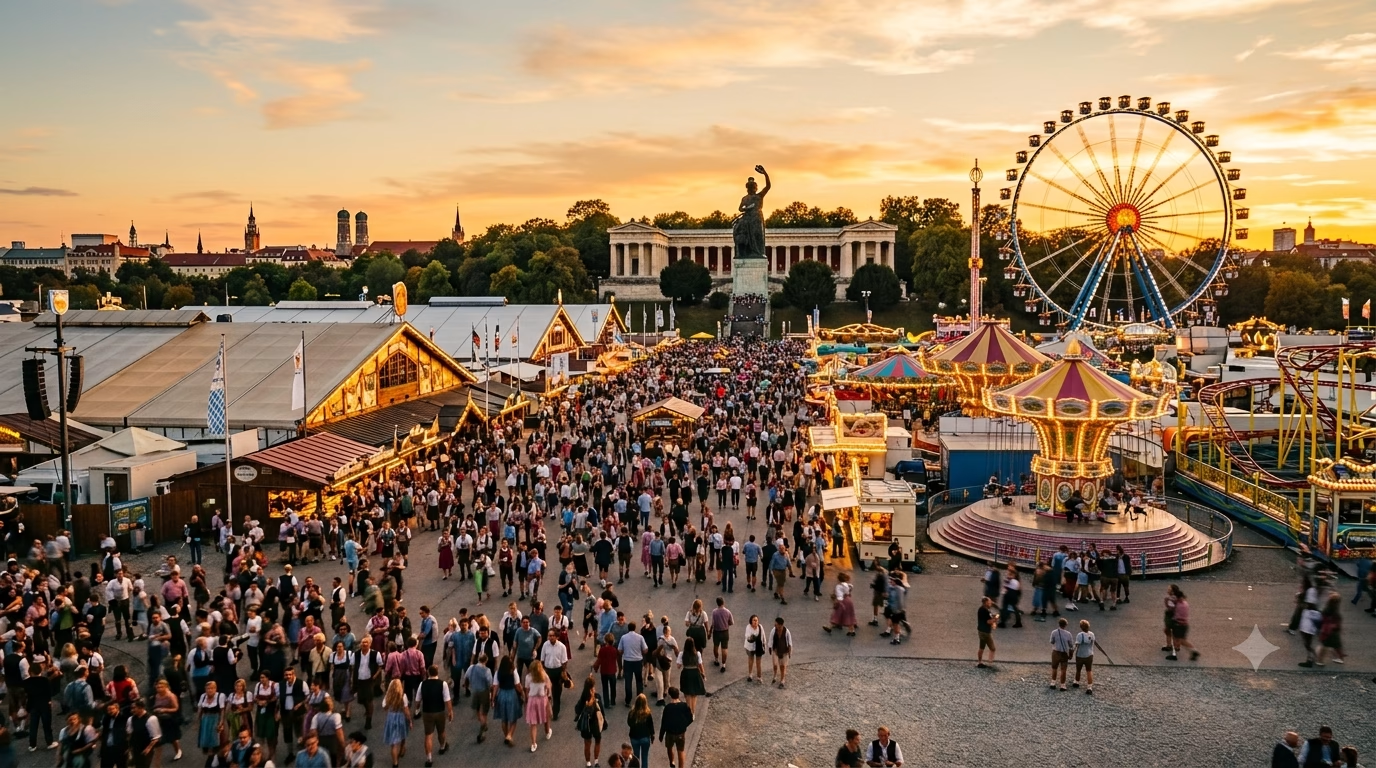
Oktoberfest 2026 in Munich is expected to run from Saturday, 19 September to Sunday, 4 October 2026 (the standard 16-day schedule that Munich follows most years). On the ground at Theresienwiese, the rhythm is fairly consistent: beer tents typically open around 10:00 on weekdays and around 09:00 on weekends, with last call usually before closing. For planning purposes, assume the grounds stay lively until late evening, but tent service generally winds down by ~22:30 and tents close around 23:00 (some nights can run a touch later depending on the venue and program). You can confirm exact daily hours and the full programme on the official Oktoberfest site.
The first weekend is the one most travelers regret not understanding ahead of time. Opening day (Sat, 19 Sept) is when Munich does the ceremonial start: the “Einzug der Wiesnwirte” (the Oktoberfest innkeepers’ and breweries’ parade) traditionally rolls into the Theresienwiese in the late morning. The headline moment follows at the Schottenhamel tent: the mayor’s first keg tapping—“O’zapft is!”—happens around 12:00, and that’s when the whole festival truly begins (expect crowds to spike sharply right before noon).
Sunday, 20 September is typically the big “heritage” day: the Trachten- und Schützenzug (traditional costume and riflemen’s parade) is the one photographers and culture-lovers aim for. It usually starts in the morning and passes through central Munich toward the Wiesn. A practical tip: if you want a good viewing spot without being crushed, aim for a position along Maximilianstraße or near Odeonsplatz and show up early—this parade draws locals, not just visitors.
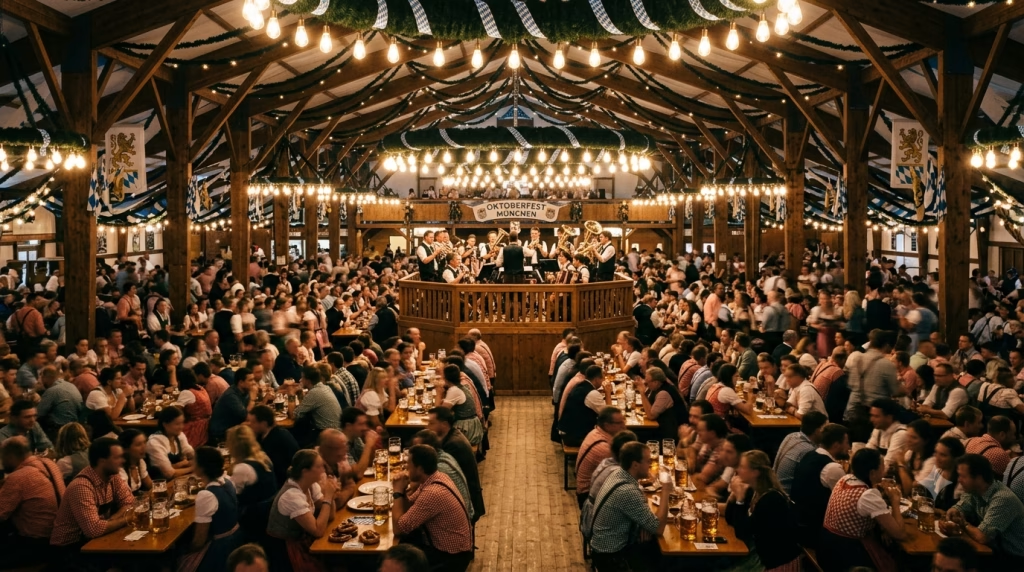
Inside the tents, highlights aren’t just “music and beer”—they’re scheduled rituals. Most big tents have brass band blocks in the daytime (easier to chat, better for families) and a louder party shift later. Sundays often feel more traditional, while midweek nights can be rowdier. If you’re trying to time a specific vibe, go weekday lunchtime for a calmer experience and more seating without a reservation; save Friday/Saturday evenings for maximum atmosphere (and maximum chaos).
- Best “classic” windows: weekdays 11:00–15:00 (more tables free, easier service)
- Peak crush periods: opening weekend; Saturdays after ~17:00; the final weekend
- Final day (Sun, 4 Oct): a sentimental, busy close—good for one last tent visit, but expect early “last chance” crowds
Watch out for the #1 timing mistake at Oktoberfest 2026 in Munich: arriving late afternoon on opening Saturday and assuming you can just walk into a headline tent. Even if the grounds are open, popular tents can stop admitting people when they hit capacity. Have a Plan B tent in mind, and keep your group coordinated—this is where reliable mobile data actually matters, because meeting points around the Bavaria statue or specific tent entrances get clogged fast. A travel eSIM makes it much easier to share live locations, pull U-Bahn directions, and message when someone gets turned around at a security checkpoint. Set up a Europe eSIM before you fly and it connects the moment you land—no airport kiosk queue.
Must-Try Food and Beverages: A Culinary Journey
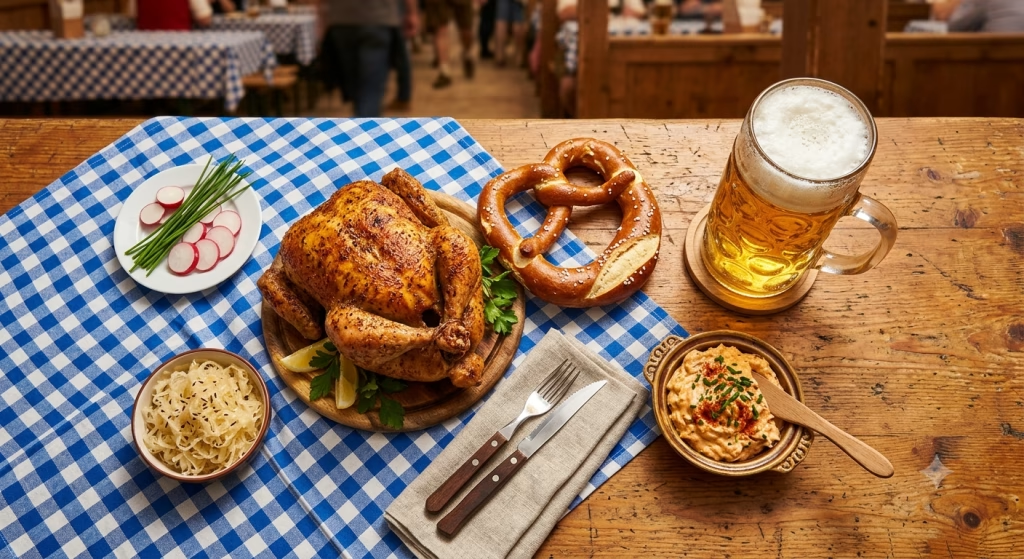
At Oktoberfest 2026 in Munich, the food isn’t just “festival fuel”—it’s the difference between enjoying your second Maß and feeling it hit you on an empty stomach. Inside the big tents (and many smaller ones), you’ll see the classics repeated across menus, but quality and portion sizes vary by tent, so it’s worth ordering the things Bavaria does best.
Start with the essentials: a Hendl (roast chicken) is the most reliable crowd-pleaser—crackly skin, simple seasoning, and it comes fast even when kitchens are slammed. If you want something more “Munich,” go for Schweinshaxe (pork knuckle): it’s heavy, shareable, and usually served with Kartoffelknödel (potato dumpling) and rich gravy. For sausage lovers, Bratwurst plates are easy, but the sleeper hit is Obatzda (spiced Camembert cheese spread) with a big Brezn—it’s salty, creamy, and made for beer.
- Must-try dishes: Hendl, Schweinshaxe, Obatzda + Brezn, Steckerlfisch (grilled fish on a stick—smoky and great if you want a break from pork), Käsespätzle (cheesy noodles, solid vegetarian option), Radi (spiral-cut radish—peppery, cleansing between sips).
- Sweet finish: Kaiserschmarrn (shredded pancake with plum compote) or Apfelstrudel; both are ideal if you’re pacing a long afternoon.
Beer-wise, Oktoberfest beer is served almost exclusively as a Maß (1 liter). Expect it to drink smoother than it sounds but land stronger than regular lager—so pair every round with food. Prices move year to year; for Oktoberfest 2026 in Munich, a realistic planning range is about €14–€18 per Maß depending on tent and timing. If beer isn’t your thing, most tents have Radler (beer + lemon soda), alcohol-free options, and usually at least one wheat beer—just know the pace of table service is built around Maß orders.
Where to eat before/after the tents (useful when tents are full or you want something quieter): around the festival grounds, Augustiner Bräustuben near Landsberger Straße serves classic Bavarian plates in a more local dining-room vibe. If you’re heading back toward the center, Viktualienmarkt is perfect for a daytime graze (cheese, sausages, bakery stops) without committing to a full sit-down. For a late-night bite when kitchens at the Wiesn are slowing down, the area around Sendlinger Tor has more reliable “still-open” options than the immediate Theresienwiese edge.
Watch out for this common mistake: cashless assumptions. Some tents and stands have improved card acceptance, but it’s not uniform, and mobile payment can be inconsistent in dense crowds. Have a backup plan: bring a bit of cash, and keep a data connection ready so you can check menus, find nearby alternatives, or coordinate a meetup if your group splits. A Telekonek eSIM is a practical setup for Munich—install it before you arrive, then you’re not hunting for spotty festival Wi‑Fi when you’re trying to locate your tent, your table, or your friends.
Essentials for Your Oktoberfest Experience: What to Bring
Pack for mud, beer spray, and long bench sessions—that’s the real trio of Oktoberfest 2026 in Munich. Theresienwiese can flip from dusty to slippery fast after a rain, and the “I’ll just wear trainers” plan usually fails by hour three when you’re standing shoulder-to-shoulder in a packed aisle.
Clothing that actually works (and why): traditional outfits look great, but they’re also practical—tight crowds, constant sitting/standing, and the occasional spilled Maß. If you’re buying locally, aim for Sendlinger Straße or around Marienplatz for a range of shops; avoid ultra-cheap costume sets that tear at the seams when you sit on the benches.
- Dirndl / Lederhosen (optional but useful): Expect roughly €80–€150 (2026) for a decent entry-level set; better-quality pieces run higher but survive multiple wears.
- Closed-toe shoes with grip: Leather sneakers or boots beat flimsy flats—broken glass happens, especially near exits late evening.
- Light rain layer: A packable jacket you can stuff under a bench; umbrellas are a pain in dense crowds.
- Warm mid-layer: Nights cool down even when tents are hot—walks to U-Bahn stations can feel chilly.
What to carry (keep it small): many entrances do bag checks, and big backpacks slow you down. A compact crossbody that zips fully is ideal—pickpocketing isn’t constant, but it spikes in crush points near tent entrances and the main lanes.
- Cash + one card: Card acceptance varies by tent and kiosk; cash keeps lines moving when the network is overloaded.
- Photo ID: Especially if you look under 25; checks happen at tent doors.
- Band-aids + blister patches: New shoes plus kilometers of walking equals misery without them.
- Portable charger: You’ll use your phone constantly for meet-ups, maps, and last-train timing.
Navigation tip that saves the night: set an offline meet-up point before you enter a tent (e.g., “by the big maypole-style sign near the main aisle”) because messages can lag when the grounds are packed. A reliable data connection helps, so preload Munich maps and run a Telekonek eSIM—it’s one less thing to troubleshoot when your group gets split at the entrance checks.
Watch out for the “bench trap”: once your table is full, leaving for the restroom can mean you don’t get back in—some tents restrict re-entry when they’re at capacity. Go as a pair, keep essentials on you (not under the bench), and don’t rely on a jacket “saving” a seat; staff often clear loose items for safety.
Navigating Munich: Transportation Tips for Oktoberfest Goers
Getting to Oktoberfest 2026 in Munich (fast vs cheap): If you’re flying, the simplest route is Munich Airport (MUC) to the center on the S-Bahn. S1 and S8 both run to Marienplatz in roughly 40–50 minutes; buy an Airport-City ticket or a day ticket depending on your group size (expect roughly €15–€20 for common airport-to-city options in 2026). From elsewhere in Germany, Deutsche Bahn’s long-distance trains into München Hbf are the most practical because you arrive already inside the U/S-Bahn network—useful when streets near the festival get traffic-calmed and ride-hails crawl.
Reaching Theresienwiese (the festival grounds): The two easiest stations are Theresienwiese (U4/U5) and Goetheplatz (U3/U6). On peak evenings, Goetheplatz tends to be slightly less chaotic because it spreads people out onto different approaches; you’ll still walk 8–12 minutes, but you’re not funneled into a single choke point. If you’re coming from central Munich, München Hbf is also walkable—about 15–20 minutes—and that walk can actually be faster than squeezing onto a packed platform right after tent closing.
- Fastest (when it’s packed): Walk from München Hbf or Hackerbrücke.
- Smoothest: U-Bahn to Goetheplatz, then walk in.
- Most direct: U4/U5 to Theresienwiese, but expect crowds.
Tickets and passes that actually matter: MVV day tickets are usually the best value if you’ll do more than two rides (think hotel → Wiesn → late-night food → hotel). Groups should look at a Group Day Ticket (often cheaper than separate singles). Avoid buying onboard—Munich ticket control is real, and fines are expensive; use MVV ticket machines or the MVV app so you’re not fumbling with cash in a crowd.
Parking (and why you probably shouldn’t): Driving into the center during Oktoberfest 2026 in Munich is a self-inflicted problem: closed lanes, police-controlled crossings, and garages that hit “full” early. If you must have a car, use P+R lots on the outskirts and take the U/S-Bahn in; it’s cheaper than central garages and you won’t be trying to navigate after a few Maß. Also: Oktoberfest policing around the grounds is strict—don’t gamble with “I’m fine to drive.”
Busy-environment navigation tips (what goes wrong): The most common failure point is meeting up. Inside and around the Wiesn, messages can lag and friends drift; pick a concrete landmark outside the gates (a specific station exit at Goetheplatz, or a named corner near a tent) and a time window. Keep a live map open and pin your meeting point—reliable data is the difference between a 10-minute regroup and an hour of circling. A Telekonek eSIM is a practical setup before you land (no shop queues), and it keeps navigation and messaging stable when you’re bouncing between stations, tent entrances, and late-night kebab stops.
Accommodation Options: Where to Stay for Oktoberfest
For Oktoberfest 2026 in Munich, where you sleep matters almost as much as which tent you end up in—because the ride home at 01:00 is when the city’s geography suddenly becomes very real. The easiest bases are the stations that drop you onto Theresienwiese with minimal transfers: München Hbf (walkable), Poccistraße (U3/U6), Goetheplatz (U3/U6), and Schwanthalerhöhe (U4/U5). Staying anywhere along those lines is usually more valuable than being “central” on a map.
Hotels (comfort, cost, and predictable logistics) are concentrated around Hauptbahnhof, Westend, and Sendling. In festival weeks, expect sharp jumps: a solid midrange chain like Mercure München City Center or Novotel München City Arnulfpark often lands around €220–€400/night (2026 range) depending on day-of-week; independent options like Hotel Deutsche Eiche (Gärtnerplatz area) can be similar when demand spikes. The upside is late check-in, luggage storage, and a quiet reset—useful if you’re doing back-to-back tent days.
Hostels (best value if you can handle noise) sell out early but can still beat hotel pricing, especially midweek. Wombat’s City Hostel Munich Hauptbahnhof and Euro Youth Hotel put you steps from the U/S-Bahn; expect roughly €60–€120 per dorm bed and €140–€260 for privates (2026 range). If you book dorms, pay attention to locker size—Dirndl/Lederhosen plus a jacket often doesn’t fit the tiny ones.
Apartments (space, kitchens, but stricter rules) are great when you’re staying 4+ nights or traveling in a group—splitting a two-bedroom can undercut two hotel rooms. The catch during Oktoberfest: hosts may enforce no late check-in, quiet hours, and no visitors, and cancellations can be painful. If you’re planning long tent evenings, pick a place with self check-in and read the fine print about keys—losing them on a big night gets expensive fast.
Camping (cheapest bed, most chaotic mornings) is a real option on the outskirts—popular Oktoberfest campgrounds typically bundle tents, breakfast, and shuttle-style transport into the city. Prices vary wildly by “package,” but it’s often the lowest per-night option when Munich hotels spike. What goes wrong: wet weather turns fields into mud, and charging your phone becomes a daily competition—bring a power bank and a backup plan for getting back if you miss the last group transport.
- Best “easy mode” neighborhoods: Westend/Schwanthalerhöhe (close + calmer), Sendling (fast U3/U6), Giesing (often cheaper, still connected).
- Where to be careful: right around München Hbf can be loud late-night; it’s convenient, but choose properties with good soundproofing and higher review scores for cleanliness.
- Booking tactic that actually helps: prioritize free cancellation, then lock something in early—even if it’s not perfect—because you can later swap when a better rate pops up.
One practical detail people underestimate: you’ll lean heavily on maps, transit updates, and last-minute meetups when crowds split your group. Set up connectivity before you arrive—having a Telekonek eSIM already active means you can navigate from the station to your hotel, message your table crew when cell networks get congested, and pull up your booking details without hunting for stable Wi‑Fi in a packed lobby.
Staying Connected During Oktoberfest: Mobile Data and eSIM Options
During Oktoberfest 2026 in Munich, your phone stops being a nice-to-have and becomes logistics: tent meet-ups when the network is busy, last U-Bahn timing, and that one friend who “just stepped outside for a minute” and vanished into the crowds. The catch is that Theresienwiese is a perfect storm for congestion—tens of thousands of devices in a tight area—so you want a plan that doesn’t depend on hunting for a stable hotspot at 21:30.
Your best baseline: reliable mobile data. If you’re visiting from outside Germany, an eSIM is the cleanest way to avoid airport kiosk lines and surprise roaming bills. Telekonek is a practical option because it offers eSIM data plans that work in 200+ countries, and you can activate before you land—useful when you need maps from München Hbf to your hotel or to message your group as soon as you step off the S-Bahn. If your phone supports dual SIM, keep your home SIM active for calls/SMS (bank codes) and run data on the eSIM.
- eSIM (most convenient): install via QR code, top up digitally, no shop visit. Best for travelers arriving during peak check-in hours.
- Local SIM (more friction): you’ll need your passport to register, and finding an open shop late on a festival night is a hassle. Mainly worth it if you’re staying for weeks and want a German number.
- Roaming (simple, risky): fine for EU visitors with inclusive roaming; for non-EU plans it can get expensive fast if you stream or upload videos.
Wi‑Fi exists, but it’s not something to plan your day around. Some tents and nearby venues offer guest Wi‑Fi, yet it’s often overloaded or requires a captive portal that times out when your phone locks. A better strategy is to download offline maps (Google Maps: Munich area + “Theresienwiese”), pin your hotel, and save key stations (München Hbf, Goetheplatz, Poccistraße) so you can navigate even if speeds drop.
Watch out for two common connection fails at Oktoberfest 2026 in Munich: (1) your battery dies early because constant weak-signal searching drains it—carry a small power bank and a short cable; (2) you connect to “free Wi‑Fi” networks with similar names near the grounds. Avoid anything that asks for odd permissions, and never log into banking on random public Wi‑Fi. If you’re posting photos/videos, wait until you’re back at the hotel or on a stable connection—upload queues plus festival congestion can chew through data and battery surprisingly fast.
Cultural Etiquette: Do’s and Don’ts at Oktoberfest
Oktoberfest 2026 in Munich runs on a mix of genuine Bavarian tradition and strict crowd-control. If you treat the tents like a nightclub, you’ll hit friction fast—security, servers, and locals have a low tolerance for “festival tourist” behavior, especially after dark.
Do: greet, ask, and earn your seat. In packed tents, you don’t “find a table,” you’re effectively invited into one. The simplest opener is “Ist hier noch frei?” (is this free?) before you slide onto a bench. If a reserved sign appears (often evenings), respect it—hosts and staff will enforce it, and you can be moved even mid-drink.
Don’t: stand on benches unless the whole table is doing it. Singing happens, standing happens—but jumping, stomping, or standing alone on a bench is a quick way to get shouted down or escorted out. It’s not about being uptight; benches are narrow, spills are constant, and injuries create chaos for staff who are already carrying heavy trays through tight aisles.
Do: know how ordering works. In most big tents, you’re served by a specific waiter/waitress covering your section; chasing a different server or waving cash around usually backfires. Pay promptly, keep small notes/coins handy, and tip in a German way: round up and say the total (e.g., “Mach’ 15” when it’s €14,20). It’s faster, and speed matters when service is slammed.
Don’t: try to “outsmart” the Maß rules. One Maß is 1 liter—pace it with food and water. Also, don’t take glass steins outside: exits are monitored and staff are trained to stop it. The “souvenir” move is one of the most common reasons people get into confrontations at the doors.
- Photo etiquette: Ask before filming strangers at your table—many groups are fine with it, some aren’t, and drunk misunderstandings escalate quickly.
- Smoking/vaping: Expect restrictions inside; don’t assume you can vape at the table just because it’s loud and crowded.
- Toilets: Don’t cut lines—people notice, and the pushback is immediate.
Watch out for the classic “lost friend” spiral at Oktoberfest 2026 in Munich. In the crush around tent exits, people get separated and phones die at the worst time. Set a specific meet point outside your tent (a named entrance or a fixed landmark on the Wirtsbudenstraße side), and keep it pinned on your map. Having reliable data helps when the network is overloaded—this is where a Telekonek eSIM earns its keep, because you can message, share location, and navigate to the right U-Bahn without hunting for Wi‑Fi that’s already saturated.
Exploring Beyond Oktoberfest: Nearby Attractions
If you’re building a full trip around Oktoberfest 2026 in Munich, give yourself at least one “non-tent” day in the city—your body will thank you, and Munich rewards slow mornings. Start with Altstadt: hit Viktualienmarkt early (most stalls are best before lunch crowds), then walk five minutes to St. Peter’s Church (Alter Peter) for the tower climb—on a clear day you can see the Alps. If you want a beer-garden reset without the Oktoberfest intensity, go to the Chinesischer Turm in the Englischer Garten; it’s classic Munich, and you can actually hear yourself talk.
For something more “Munich local” than postcard Munich, spend an afternoon around Gärtnerplatz and the Glockenbachviertel—good cafés, small boutiques, and a calmer pace than the pedestrian crush near Marienplatz. If you like museums, the Kunstareal (near Königsplatz) is an easy cluster so you’re not crisscrossing town; it’s ideal when the weather turns and Theresienwiese becomes a mud-and-poncho scene.
Day trips from Oktoberfest 2026 in Munich are where Bavaria really opens up. The most practical (and least stressful) options by train:
- Neuschwanstein & Hohenschwangau (Füssen): train to Füssen (~2 hours), then bus to the castles. It’s beautiful—but it’s also the #1 place where people waste half a day queueing because they didn’t lock a timed entry.
- Salzburg: direct trains run regularly (often ~1.5–2 hours). Go for an early train, do Mirabell Gardens + Old Town on foot, and be back in Munich before late-night festival crowds hit the platforms.
- Nürnberg: about an hour by fast train; great if you want a completely different city feel—medieval walls, serious history sites, and a less “Alpine” Bavaria vibe.
Watch out for one common mistake: underestimating how long it takes to do anything the morning after a late tent session. If you’re planning Neuschwanstein or Salzburg, book the first train you can realistically catch (not the earliest one on the timetable), and build in a buffer for finding the right platform at München Hbf when it’s busy. Also, keep an eye on Sunday schedules—some attractions and smaller businesses run shorter hours, which can turn a “quick stop” into a closed door.
To make these side trips smoother, keep your maps, train updates, and reservations accessible on the go—especially when you’re bouncing between U-Bahn, regional trains, and castle buses. If you’re extending the trip across Europe, our 10-day Spain and Italy itinerary lays out another rail-friendly route worth stealing from. Either way, sort your data before you fly: a Europe eSIM lets you land with working mobile data immediately, which is a lifesaver when you need the right platform change, a live delay notification, or a backup route after service disruptions.
Key Takeaways
- Dates: Oktoberfest 2026 in Munich runs Saturday 19 September to Sunday 4 October at Theresienwiese, with the first keg tapped at the Schottenhamel tent around noon on opening day.
- Beat the crowds: weekday lunchtimes (11:00–15:00) are calmest; opening weekend, Saturday evenings, and the final weekend are peak crush.
- Eat and pace yourself: order a Hendl or Schweinshaxe, treat the Maß (1 litre, ~€14–€18) with respect, and pair every round with food.
- Get there smart: take the U-Bahn to Goetheplatz or Theresienwiese, buy an MVV day or group ticket, and skip driving into the centre.
- Pack for it: closed-toe shoes with grip, a light rain layer, a small zip crossbody, cash plus one card, and a power bank.
- Stay connected: set up a Europe eSIM before you fly so maps, meet-ups, and tickets keep working when the grounds are congested.